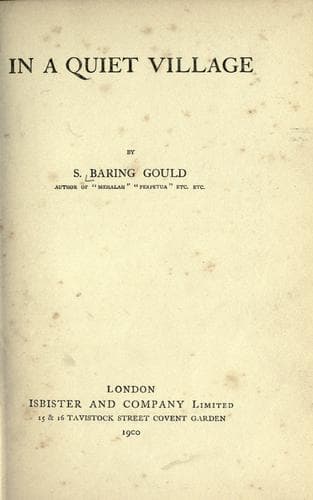
England -- Fiction; Short stories, English; Villages -- Fiction; Wales -- Fiction
He remained for some little while drawing a salary and doing some
off-and-on work, very much against his taste, as Scripture reader, for
it was a position for which he was totally unqualified. At last he
became uneasy in his conscience, he felt he was earning money he did not
deserve, and the work was uncongenial. Then he saw an advertisement from
my predecessor at Dalton for a young man to act as man-servant, sing in
the choir—(“Bray, rather,” said I to myself)—and attend to the church.
This was exactly what he wanted. He answered, was accepted; and I found
him at Dalton, and kept him on.
I have said that Mr. Mills, or Brother Augustine, wore two different
aspects.
Usually, about the house and at church he wore a cassock, and a little
black square cap set on the back of his head.
When not engaged about the church, he was generally to be seen seated
cross-legged on the kitchen table, making a suit for me, or mending or
making clothes for himself.
But, when Mr. Mills was dressed to go to Thirsk, the market town, he
was as though he had walked out of a bandbox—dapper, spick and span in
everything; a masher one would call him now, but in 1866 the word was not
invented.
A most disinterested fellow he was. I did not pay him any wage. He had
his food and room with me, and nothing else. If he wanted to go to York
or Ripon, I gave him his fare, and a shilling to spend as he liked. He
never had more whilst with me for two years. His mind was like that of a
child. He was happy over the merest trifles, and upset also by trifles.
A good-hearted fellow with a limited education, very fond of puss, and
devotedly attached to animals. Every one laughed at him, but every one
liked him. He would do anything that I asked him to do, and go anywhere.
I had an old housekeeper, a worthy woman who was a widow, and she and
Mills were always laughing, and, when not laughing, he was singing. The
kitchen was immediately opposite my one sitting-room, and as the door was
generally open, they made a good deal of noise, to which I had to become
accustomed.
One morning Mr. Mills appeared in lavender small-clothes, a black frock
coat, white waistcoat, straw-coloured kid gloves, and a silk hat that
shone as if it had been oiled. In his button-hole he wore a stephanotis.
His face was twinkling with smiles.
He appeared before me flourishing a Malacca cane.
“Why—Brother Augustine! what are you about?” I exclaimed.
“I have walked through the village,” he replied, “and I want to go into
Thirsk.”
“What for?”
“Only to get a rise out of the Daltonians. You should have seen the
round eyes they made as I walked past their houses. And I have just been
into the school to show myself to the mistress and the children. I really
am curious to know to whom they will have married me—for they will all
jump to the conclusion that I have gone into Thirsk to be married.”
Public-domain text, read in full here on John Shaqi.
Reviews
Reviews
No reviews yet
Be the first to share your thoughts on this work.
Join the Discussion
Join the discussion
Sign in to leave a comment or review.
Sign InorCreate an account