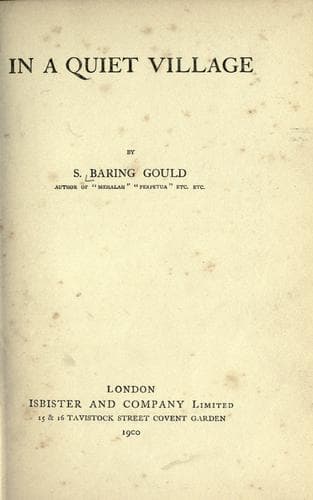
England -- Fiction; Short stories, English; Villages -- Fiction; Wales -- Fiction
My predecessor had been accustomed to have the chorister boys go to the
parsonage after the Litany, which was sung in the afternoon, and have
tea there, and hang about the garden till evensong at half-past six. I
found this a burden more than I could bear, and I announced that I was
regretfully obliged to discontinue the usage.
After having made the announcement, I was breathing free, when Mills came
to me with a blank face.
“They have struck,” he said.
“Struck what?—struck you?” I asked.
“They will not put on their cassocks and surplices and go into the choir
this evening.”
“Well, Mr. Mills, then we will manage without them.”
So we did. One, faithful among the faithless found, did put on his
surplice. A little fellow who could not read. However, we sang the whole
service, psalms, responses, _Magnificat_, _Nunc Dimittis_, hymns, just as
though we had a full choir. I do not think there was any musician in the
congregation that evening, for I do not recall any one being carried out
fainting.
There was one peculiarity about Mills that I could not break him of. He
had learned the Apostles’ Creed in the Roman version, which differed
slightly from our form, and he would always bray forth that “form of
sound words” which he had acquired in his childhood.
In 1868 there was about to be a change in my domestic arrangements—in
fact, I was about to be married—consequently I was forced, much to my
regret, to get rid of Mills.
After a little inquiry and some letter-writing, it was settled that he
should go to Christ Church and become valet to Dr. Pusey, at that time
getting old and infirm.
In the event of sickness, I knew that no one could be a more tender and
devoted nurse than Brother Augustine. There was something feminine in his
delicacy of touch and in his sweetness of manner. And he would give up
his time in the most unselfish manner possible to the doctor. Of that I
was quite confident.
So Brother Augustine departed, with tears in his eyes, and there was
not a person in the parish who was not sorry to lose him. For although
they had laughed at him, all appreciated his goodness and his kindness;
and I am not sure but that what they laughed at most was his absolute
guilelessness, his utter unworldliness, and that, to a Yorkshireman, is
indeed astonishing. I heard next of him as installed at Christ Church,
where he figured in the quad in just the same extraordinary costume as
he had worn with me; and his funny ways, his old-fashioned politeness,
and his simplicity vastly tickled the young students. I believe sundry
tricks were played on him, but I never heard any particulars.
That he was very happy I did learn from himself.
He was given a room near Dr. Pusey’s quarters in Christ Church, that
adjoined or was under another in which one of the men of the college was
lodged.
Public-domain text, read in full here on John Shaqi.
Reviews
Reviews
No reviews yet
Be the first to share your thoughts on this work.
Join the Discussion
Join the discussion
Sign in to leave a comment or review.
Sign InorCreate an account