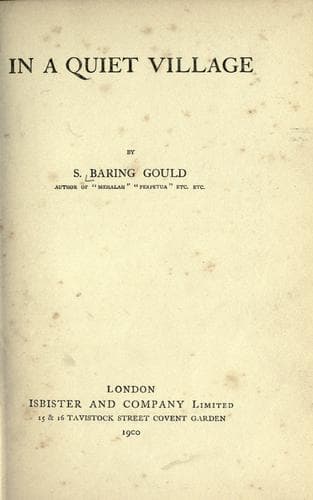
England -- Fiction; Short stories, English; Villages -- Fiction; Wales -- Fiction
Now, a remarkable occurrence in the parish took place. Aaron, _alias_
Haroun, fell in love, and took to courting Elizabeth Thomas, _alias_
Sugar-cane, _alias_ Cassabos Souccar, the tweenie maid. It took the
whole parish by surprise, for Elizabeth was not beautiful; she had not
the eyes or the frame, or the _svelte_ movements or the elastic tread of
the light gazelle. She was a somewhat heavily formed, broad-shouldered,
pudding-faced damsel, who could not cross a room without rattling all the
chimney ornaments, and who had no more imagination and genius than has a
duck. And in what did the attraction consist? Why had Aaron not become
enamoured of the lady’s-maid, a most willowy person with a very sweet
and refined face? Why not with the kitchen-maid, the Sprig of Coral,
who had indeed coralline lips, and who in time would know how to boil
a potato and do a chop so as not to be done to leather. But a tweenie!
and such a tweenie! The whole parish discussed it for a month. It was
most astounding that the man who romanced about every one and everything
and every place, should make such dead prose of his own love affair.
However, after this had been debated in the servants’ hall, at the forge,
in the stable, at the tavern, each such debate ended with some one
remarking sententiously, “After all, it is his affair and not mine.”
It is, however, a mistake to say that Aaron’s courtship was prosaic. That
it was not so was proved by one of his letters to Elizabeth Thomas, which
the girl carelessly left about; and it got read, copied, and distributed
through the village, and excited much admiration at the splendour of the
style, till some one detected the original, of which it was but a copy,
in the story of Abdul Hassan and Schemselnihar. Here is the epistle—
“AARON PRICE, _carpenter_, to ELIZABETH THOMAS, _tweenie maid_.
“Deprived of your presence, I seek to continue the illusion,
and converse with you by means of these ill-formed lines, which
afford me some pleasure, while I am prevented the happiness of
speaking to you.
“Patience, they say, is the remedy of all evils; yet those I
suffer are increased instead of relieved by it. Although your
image is indelibly engraven on my heart, my eyes nevertheless
wish again to behold the original.
“These sentiments, which my fingers trace, and in expressing
which I feel such inconceivable pleasure that I cannot repeat
them too often, proceed from the bottom of my heart, from that
incurable wound you have made in it; a wound which I bless a
thousand times, notwithstanding the cruel sufferings I endure
in your absence.
Public-domain text, read in full here on John Shaqi.
Reviews
Reviews
No reviews yet
Be the first to share your thoughts on this work.
Join the Discussion
Join the discussion
Sign in to leave a comment or review.
Sign InorCreate an account