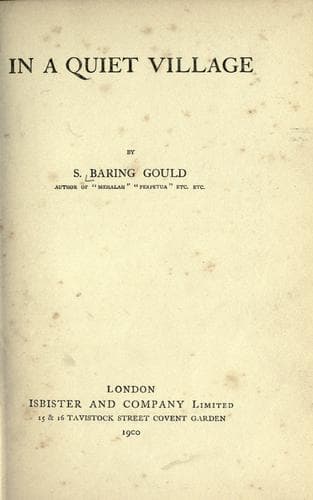
England -- Fiction; Short stories, English; Villages -- Fiction; Wales -- Fiction
“Do not imagine that my words convey more than I feel. Alas!
whatever expressions I may use, I shall still think much more
than I can ever say. My eyes, which never cease looking for
you, and incessantly weep till they shall behold you again; my
afflicted heart, which seeks but you; my sighs, which escape
my lips whenever I think on you, and that is continually; my
imagination which never reflects any object but my beloved
prince tweenie-maid; the complaints I offer to heaven of the
rigour of my fate; in short, my melancholy, my uneasiness,
my sufferings, from which I have had no respite since I lost
sight of you, are all-sufficient pledges of the truth of what I
write. I pray that we may be granted an opportunity of telling
each other, without restraint, the tender affection we feel,
and that we will never cease to love. Farewell.
“I salute Lady Vaughan, to whom we each have so many
obligations.”
Not to make too long a story of this. The course of true love ran
smoothly enough. The adored tweenie took it all very calmly, very much as
a matter of course, and in due time they were married.
No one supposed that they could be happy together, so opposite were
they to each other. Yet never did the parish see a more affectionate and
devoted couple. Aaron “yarned” to his Bessie, telling her his marvellous
tales. She knitted or darned listening with a stolid face, and when he
had done said, “Aaron, get along with your nonsense, I don’t believe in
any of your marvels.”
He took her unbelief in good part. If she did not relish his tales, it
was her misfortune and not her fault. He was soul, she was body, and each
has its proper place in the economy of nature. He was everything that was
imaginative, she was wholly commonplace, and the mixture in one household
produced not ferment, but peace.
“I wish,” said Aaron, “I wish, Lizzie, I could see wonders. I read of
them, I think of them, I tell of them, and yet I have never seen one.”
Suddenly, to the amazement of every one, Aaron died. He caught a chill
that settled on his lungs, and he was dead in three days. His wife
attended to him with devotion and unflagging solicitude. One night he
turned his bright feverish eyes on her and said—
“Liz! kiss me. I’m going at last to see wonders, and you won’t say to me
there, where I am going: ‘Get along with your nonsense.’”
He did not say another word, but passed in this eager, expectant attitude
of soul into the World of Wonders.
Every one respected Haroun, though he had perplexed all, and all had
laughed at him. His death was felt by all, and the entire parish
attended his funeral. Sir John Vaughan forgave having been converted into
Ganem, the slave of Love, and he was there.
And when Aaron was gone, all said—
“We can’t, for certain, have a more pleasant and romancing carpenter in
his place, even if we get—which is doubtful—a better workman.”
Public-domain text, read in full here on John Shaqi.
Reviews
Reviews
No reviews yet
Be the first to share your thoughts on this work.
Join the Discussion
Join the discussion
Sign in to leave a comment or review.
Sign InorCreate an account