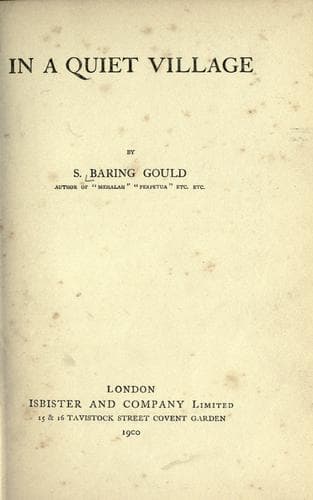
England -- Fiction; Short stories, English; Villages -- Fiction; Wales -- Fiction
The man himself was not comely. A broad-shouldered, plain man, with a
stoop such as is often seen in colliers—a reserved, a serious man, and
somewhat shy. Perhaps in this he was a typical Welshman—that he was
full of tenderness of heart and deep feeling, but at the least token
of ridicule or superciliousness, he closed like a flower against rain,
brooded over any injury his feelings may have received, but he said
nothing.
Centuries of isolation and of wrong done to the Welsh race have had
this effect on them. They have been sneered at, swaggered over by
domineering Saxons or tyrannical Normans, then exploited by speculative
North-countrymen; they have been treated as men to be employed for the
advantage of others, and when useless, to be cast aside as broken tools.
Their idiosyncrasies have been the subject of joke and scoff; their
language has been derided; their aspirations, national and individual,
disregarded. This has bred in them a sensitiveness that is foreign to
the coarser Saxon—a reserve that forms a crust about the manner that is
repellent to the stranger, if in that stranger there be the smallest
assumption of superiority. Yet underneath lies the richest, deepest,
purest vein of golden love and goodwill that God, who formed the
mountains and made man, ever buried in the human heart.
Shone had not married till he was some way past thirty, and then,
perhaps, more for convenience than that passion which whirls most men
into matrimony; and about a year after his marriage his wife gave him a
little son, but did not recover the confinement, and died.
Shone was left alone in the cottage with a baby, and he had his daily
work to accomplish in order that he and his baby might live. He could
not neglect his work, and he would not neglect his baby. Some neighbours
offered to relieve him of the child, but to this Shone was averse. The
baby was his; it was almost the only living being that was absolutely,
indisputably his own. And now it was that the fountains of love in that
closed and sealed heart opened and gushed forth. He loved that child with
a love such as only a mother, one might have supposed, could entertain
for a poor little, feeble, wailing lump of flesh.
Shone considered what he should do. He would not commit the child to
Martha Rees, who had volunteered to take it, for she was a slovenly
person, and he could not be sure that she would keep the little creature
clean. Nor to Rachel Price, for she was violent tempered when put out:
she might lose patience if the child cried, and maltreat it, though
usually she was a most good-natured woman. Nor to Alice Tooker, for she
was an Englishwoman, and he would not have his child reared save to the
sound of the Welsh tongue, and sung to sleep with Welsh lullabies.
Then Shone formed his resolve—and to this he adhered for many, many
months.
Public-domain text, read in full here on John Shaqi.
Reviews
Reviews
No reviews yet
Be the first to share your thoughts on this work.
Join the Discussion
Join the discussion
Sign in to leave a comment or review.
Sign InorCreate an account