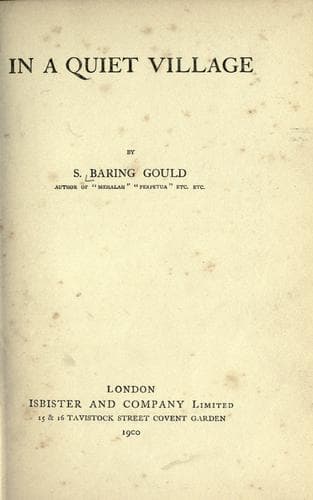
England -- Fiction; Short stories, English; Villages -- Fiction; Wales -- Fiction
And now I come to another singular fact, and fact it is. The widow,
Bessie Price, that dull, inanimate, prosaic body—soul none thought to
call her—moped and drooped after his death. Nothing roused her, nothing
interested her, she seemed to have lost everything when the earth closed
over the dear, rodomontading carpenter. Folk said at first, “Bless you,
she’s not one to feel her loss. She has not the depth in her.”
But they were mistaken. She felt her loss so deeply, so intensely, that
without any apparent malady, she drooped, faded, and from no perceptible
physical cause sank, and within twelve months, this bit of putty or dough
was laid by the quicksilver of her husband.
And so, even in this dull, heavy creature there was the poetry of love,
the romance of a life devoted to one man. Where Love is—there is the
Spirit of Poesy.
SHONE EVANS
SHONE EVANS
Shone, that is to say John, Evans was a miner in the Dulais Valley, in
South Wales, and a man nearer forty than thirty.
The Dulais Valley had been solitary, with a brawling mountain stream
flowing between great ridges of brown heathery moss-land, on which the
sheep had browsed and shone white in the sun. But of late years there had
come a transformation of the scene. Coalpits had been opened. Plain, ugly
rows of houses had been run up. Tall chimneys had been erected, chapels
and churches, public-houses, factories as well. What sheep still fed on
the hilltops were grey, if not black, for the air was heavy with smoke,
and the soot settled everywhere, and not the sweetest herb could avoid a
flavour of soot, nor the fairest flower escape a film of “smuts.”
As for the sparkling, laughing Dulais, it had turned to a sullen, dirty
stream, of which nothing was required but that it should carry off the
scum and sewage of the dense population that clogged the valley and dug
into the hills. In long-gone-by days the stream had acquired its name of
Blackwater, for so Dulais may be interpreted, from the lyns and pools of
bottle-green deeps, formed after its leaps over the barriers of rocks.
Now it merited its name more truly, so sombre was it, in the midst of
heaps of coal refuse, and so soiled were its waters with every sort of
defilement.
“Man makes the town, God made the country,” is a saying; but it is only
half true. God makes the town, for He it is who has laid the beds of
coal, and run into the rock the veins of ore that draw men to excavate
them, and without which men would hunger, and civilisation could not
progress.
Beautiful on the hills of old were the harebells, beautiful in the
evening the glory of light that lit up the russet hills—ugly, maybe, is
now the mining settlement; and yet there is a loveliness above that of
harebell and bracken and heather and foaming mountain rill in the lives
of the men and women who have invaded and displaced the rude natural
charms of the Dulais Valley. And I am going to tell you of one of these
beauties, and thus I introduce you to Shone Evans.
Public-domain text, read in full here on John Shaqi.
Reviews
Reviews
No reviews yet
Be the first to share your thoughts on this work.
Join the Discussion
Join the discussion
Sign in to leave a comment or review.
Sign InorCreate an account