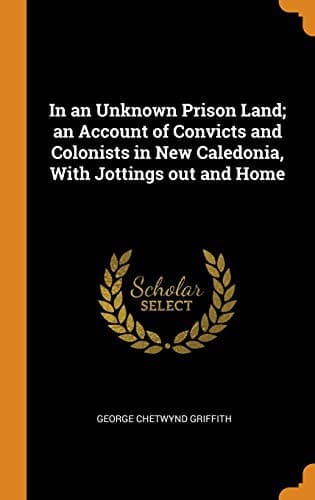
In an Unknown Prison Land: An account of convicts and colonists in New Caledonia with jottings out and homeGriffith, George Chetwynd
History
In an Unknown Prison Land: An account of convicts and colonists in New Caledonia with jottings out and home
Griffith, George Chetwynd
Crime; Criminals; New Caledonia -- Social conditions -- 19th century; Penal colonies -- New Caledonia
The next day I asked certain citizens who should have known how this
thing came to be in such a godly country, and the various answers about
came to this: “The Government and the Churches have done their best to
shut those places up, but somehow they haven’t succeeded. And then, you
see, they pay enormous rents.”
“But who owns the property?” I asked one old and highly respected
resident.
“Well, if _I_ did I shouldn’t tell you,” he replied. “Come and have a
drink!”
It was a hot day and I thought I might as well leave it at that.
Later on this moral plague-spot became a physical plague-spot as well.
The Black Death spread its sombre wings over it, and the purging fires
have swept it in smoke and flying flame from the face of the insulted
earth up to the yet more insulted heavens. Wherefore the Paradise of the
Pacific ought to be a good deal cleaner now than it was when I was there.
[Illustration: Sanford B. Dole. First Governor of the Territory of
Hawaii.]
That afternoon I called at Government House and sent my card in to Mr.
Sanford B. Dole, President of the Hawaiian Republic. He is the man who
came to the front when the reactionary tactics of King Kalakaua and
his sister and successor, Liliuokalani, raised the somewhat important
question as to whether the Hawaiian Islands were going to fall into line
with civilisation or fall back into a state of semi-barbarism—for that
is about what it came to.
President Dole is a “missionary”; that is to say, he belongs to the
clerical aristocracy of Honolulu. He is not a clergyman himself, and he
has the credit of belonging to one of the very few missionary families in
the islands which have not become wealthy.
The last President that I had interviewed was Paul Krüger, late of Kerk
Street, Pretoria. There was a very striking difference between the
two men. The Boer was bulky, slow of speech and motion, with manners
unspeakable; also little keen eyes which looked at you piercingly for a
moment, and then dodged away—cunning incarnate in the flesh and a good
deal both of the cunning and the flesh.
Still, at the time, I confess that I thought him a man, and, in his way,
a great one—not a common boodler who would squeeze his country for all
it was worth, and then, at the first note of danger, bolt with all the
plunder he could lay his hands on.
When I went into President Dole’s Council Chamber—which had once been the
Queen’s boudoir, and in Kalakaua’s time before her, the scene of many
a half-barbaric orgie—I was greeted by a tall, rather slight, but well
set-up man dressed in spotless white.
He had the air of being at once virile and venerable, for his hair and
his long, almost patriarchal beard were both grey. But the figure was
alert. He walked up and down the room the whole time we were talking.
The grey-blue eyes were quick and keen and steady. I may also add, _en
parenthèse_, that he was one of the handsomest men I have ever spoken to.
Public-domain text, read in full here on John Shaqi.
Reviews
Reviews
No reviews yet
Be the first to share your thoughts on this work.
Join the Discussion
Join the discussion
Sign in to leave a comment or review.
Sign InorCreate an account