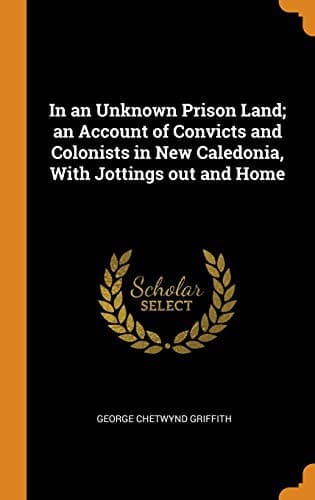
In an Unknown Prison Land: An account of convicts and colonists in New Caledonia with jottings out and homeGriffith, George Chetwynd
History
In an Unknown Prison Land: An account of convicts and colonists in New Caledonia with jottings out and home
Griffith, George Chetwynd
Crime; Criminals; New Caledonia -- Social conditions -- 19th century; Penal colonies -- New Caledonia
[Illustration: Permit to visit a Prison or Penitentiary Camp _en détail_.
This is the ordinary form; but the Author is the only Englishman for whom
the words in the left-hand corner were crossed out.]
There is quite a little romance connected with this estimable family.
When Madame came out she brought her two daughters with her. Now the
elder of these had been engaged to a young man employed at the Ministry
of Colonies, and he entered the colonial service by accepting a clerkship
at Noumea. The result was naturally a meeting, and the fulfilment of the
proverb which says that an old coal is easily rekindled. The engagement
broken off by the conviction was renewed, and the wedding followed in due
course. The second daughter married a prosperous concessionnaire, and the
ex-coiner, well established, and making plenty of properly minted money,
has the satisfaction of seeing the second generation of his blood growing
up in peace and plenty about him. Imagine such a story as this being true
of an English coiner!
A little further on, on the left hand side, is a little lending
library, and _cabinet de lecture_. This is kept by a very grave and
dignified-looking man, clean-shaven, and keen-featured, and with the
manners of a French Chesterfield. “That man’s a lawyer,” I said to the
Commandant, as we left the library. “What is he doing here?”
“You are right. At least, he was a lawyer once, doing well, and married
to a very nice woman; but he chose to make himself a widower, and that’s
why he’s here. The old story, you know.”
Next door was a barber’s shop kept by a most gentle-handed housebreaker.
He calls himself a “capillary artist,” shaves the officials and
gendarmerie, cuts the hair of the concessionnaires, and sells perfumes
and soaps to their wives and daughters. He also is doing well.
A few doors away from him a _liberé_ has an establishment which in a way
represents the art and literature of Bourail. He began with ten years
for forgery and embezzlement. Now he takes photographs and edits, and,
I believe, also writes the _Bourail Indépendent_. As a newspaper for
ex-convicts and their keepers, the title struck me as somewhat humorous.
Nearly all branches of trade were represented in that little street. But
these may be taken as fairly representative samples of the life-history
of those who run them. First, crime at home; then transportation and
punishment; and then the effort to redeem, made in perfect good faith by
the Government, and, so far as these particular camps and settlements are
concerned, with distinct success in the present.
Unhappily, however, the Government is finding out already that free
and bond colonists will not mix. They will not even live side by side,
wherefore either the whole system of concessions must be given up, or the
idea of colonising one of the richest islands in the world with French
peasants, artisans, and tradesmen must be abandoned.
Public-domain text, read in full here on John Shaqi.
Reviews
Reviews
No reviews yet
Be the first to share your thoughts on this work.
Elsewhere in the archive
Join the Discussion
Join the discussion
Sign in to leave a comment or review.
Sign InorCreate an account