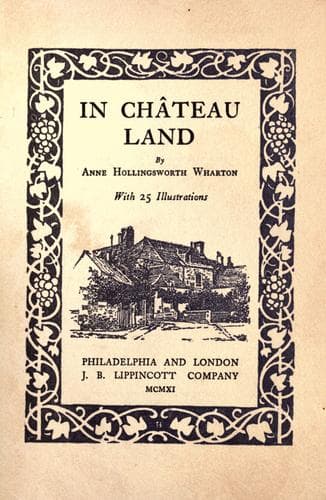
Castles -- France; Touraine (France) -- Description and travel
WE STOPPED at this interesting old town last night in order to break the
long journey from Geneva to Paris. Dijon, which has only been to us a
station to stop in long enough to change trains and to look upon
longingly from the car windows, proves upon closer acquaintance to be a
town of great interest. After a morning spent among its churches and
ancient houses and in its museum, we were quite ready to echo the
sentiments of an English lady whom we met at the _table d'hote_, who
spends weeks here instead of days, and wonders why travellers pass Dijon
by when it is so much more worth while than many of the places they are
going to. So much is left of the ancient churches and buildings to
remind one of the romantic and heroic history of Dijon, that it seems
eminently fitting that we should make this stop-over, a visit to the
capital city of Burgundy being a suitable prelude to a sojourn among
the chateaux of the French kings, who had their own troubles with these
powerful lords of the soil. The present Hotel de Ville was once the
palace of the Dukes of Burgundy. Little is now left of the original
building with the exception of the ancient kitchens, and these, with
their half-dozen great ventilating shafts, give one the impression that
those doughty old warriors had sensitive olfactories.
In the Cathedral of Saint Benigne, who seems to be the patron saint of
Dijon, are the remains of the great Dukes of Burgundy, although their
magnificent tombs are in the museum. The Cathedral of Saint Benigne has
a lovely apse and other architectural charms; but Notre Dame captivated
us utterly, so wonderful are its gargoyles representing man and beast
with equal impartiality, their heads and shoulders emerging from a rich
luxuriance of sculptured foliage, the whole indescribably beautiful and
grotesque at the same time. It is not strange that the carved figure of
a plump and well-fed Holy Father, with his book in one hand and food in
the other, sitting beside an empty-handed and mild-faced sheep, should
have called forth such lines as the following from some local poet,
evidently intended for the remarks of the sheep:
"LES ESPRITS-FORTS.
Volontiers les humains s'apellent fortes-tetes
Qui la plupart du temps ne sont que bonnes betes
Et qui juste en raison de leurs etroits esprits
De leurs maigres pensers sont beaucoup trop epris."
Public-domain text, read in full here on John Shaqi.
Reviews
Reviews
No reviews yet
Be the first to share your thoughts on this work.
Join the Discussion
Join the discussion
Sign in to leave a comment or review.
Sign InorCreate an account