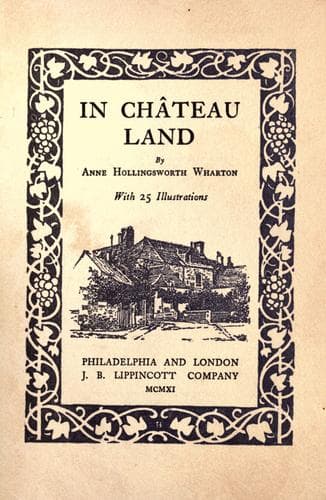
Castles -- France; Touraine (France) -- Description and travel
Other decorators and sculptors of these ancient buildings have, like Fra
Lippo Lippi, worked their own quaint conceits and humorous fancies into
their canvases and marbles, and we to-day are filled with wonder at
their cleverness, as well as over the excellence of their art, so
exquisite is the carving of leaf and branch and vine. One would need to
come often to the Galerie des Tours of Notre Dame to fully enjoy it, and
other beauties of this church, whose tower is crowned by a curious clock
with moving figures, called Jacquemart, after the Flemish mechanician
Jacques Marc who designed it. The Jacquemart, with his pipe in his
mouth, stolidly strikes the hours, undisturbed by the cold of winter or
the heat of summer, as some Burgundian poet of the sixteenth century has
set forth in a quaint rhyme.
Near the cathedral is a charmingly picturesque building called La Tour
de Bar, where Rene d'Anjou, Duke of Bar and Lorraine, was imprisoned
with his children. In the museum, which possesses many treasures in
painting and sculpture, we saw the magnificently carved tombs of
Philippe le Hardi and Jean Sans-Peur. Here, with angels at their heads
and lions couchant at their feet, the effigies of these Dukes of Valois
rest, surrounded by a wealth of sculpture and decoration almost
unequalled. It would be well worth stopping over night at Dijon if only
to see the magnificent tombs of these bold and unscrupulous old warriors
and politicians. Jean Sans-Peur planned and accomplished the
assassination of Louis d'Orleans and was himself overtaken by the
assassin a few years later. The tomb of the boldest and bravest of them
all, Charles le Temeraire, you may remember, we saw at Bruges. The lion
at the feet of the last Duke of Burgundy, with head upraised, seems to
be guarding the repose of his royal master, who in his life found that
neither statecraft nor armies could avail against the machinations of
his arch-enemy, Louis XI.
Beautiful and impressive as are these tombs, the true glory of Dijon is
that the great Bossuet was born here and St. Bernard so near, at
Fontaine, that Dijon may claim him for her own; and Rameau, the
celebrated composer; Rude, whose sculptures adorn the Arc de l'Etoile in
Paris; Jouffroy, and a host of other celebrities, as we read in the
names of the streets, parks, and boulevards, for Dijon, like so many
French cities and towns, writes her history, art, literature, and
science on her street corners and public squares, thus keeping the names
of her great people before her children.
Public-domain text, read in full here on John Shaqi.
Reviews
Reviews
No reviews yet
Be the first to share your thoughts on this work.
Join the Discussion
Join the discussion
Sign in to leave a comment or review.
Sign InorCreate an account