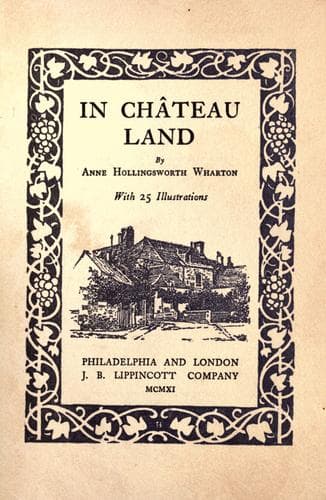
Castles -- France; Touraine (France) -- Description and travel
We were tempted to linger so long in the grounds that we had only a
short time to spend in the interesting eleventh century church which
adjoins the park and, like the chateau, belongs to the State. The
facade of the church is richly decorated with quaint statuettes and
carvings, and here also is a seigniorial chapel with inscriptions of the
Biencourt family who owned the chateau of Azay-le-Rideau before it
passed into the hands of the government.
Our appetite for chateaux has so increased with the seeing of them that
we regretted not having time to go to Usse this same afternoon, but we
shall have to make a separate trip to this palace, which is said to be a
superb example of Gothic architecture. Although the chateau is often
inhospitably closed to visitors, its exterior, with innumerable towers
and tourelles, and the terraces, gardens, and vast park, nearly seven
miles in circumference, are well worth a visit.
As usual, the afternoon was not long enough, and the shortening
September light warned us that we must take a train from the station at
Azay-le-Rideau about six in order to reach Tours in time for dinner.
VII
TWO QUEENS AT AMBOISE
PENSION B----, TOURS, September 5th.
THIS morning we spent at the Chateau of Amboise, which we reached by
crossing two bridges over the Loire, as the wide river is divided at
this point by the Isle St. Jean. None of all these beautiful royal
castles owes more to the Loire than Amboise, whose magnificent round
machiolated tower commands the approaches to the bridge, while the fine
pointed windows and arched balcony give a fairyland lightness and grace
to the adjoining facade which crowns a bluff high above the river.
We reached the chateau by many hillside steps, and through a garden
which stands so high upon its terrace above the street that it seems,
like the famous gardens of Babylon, to hang in the air. Upon a nearer
view we found that the garden rests upon a solid foundation of rock and
earth, and is surrounded by strong walls and parapets of masonry. From
these walls the light buttresses of the little Chapel of St. Hubert
spring. This lovely chapel, which with its fine delicate spire and
chiselled pinnacles, standing out against the blue sky, gives an effect
of indescribable beauty, was built by Charles VIII after his return from
Italy. The wonderful carvings above the doorway, representing St.
Hubert's miraculous encounter with a stag, were doubtless executed by
Italian workmen whom he brought with him, as only skilled hands could
have produced a result so rich and decorative and yet so exquisitely
fine and delicate. Other beautiful carvings ornament the facade and the
interior of the chapel, which in form is a miniature Sainte Chapel, less
brilliant in color and richer in carving than the ancient Chapel of St.
Louis, in Paris.
Public-domain text, read in full here on John Shaqi.
Reviews
Reviews
No reviews yet
Be the first to share your thoughts on this work.
Join the Discussion
Join the discussion
Sign in to leave a comment or review.
Sign InorCreate an account