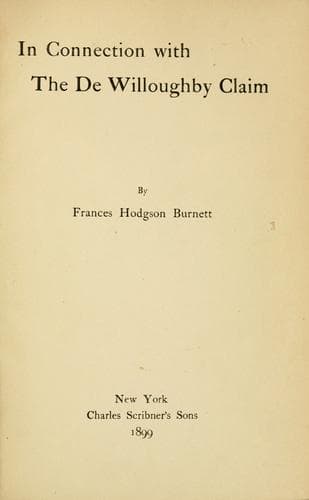
In Connection with the De Willoughby ClaimBurnett, Frances Hodgson
General
In Connection with the De Willoughby Claim
Burnett, Frances Hodgson
United States -- Social life and customs -- 19th century -- Fiction
It was the turning-point of his existence. He made his bitter resolve as
he walked out of the house down the street. Early as it was, he went
straight to Delia, and when he found himself alone with her, poured forth
all the misery of his sore heart.
"If I had been born a clod-hopper it would have been better for me," he
said. "I have no place here among men with decently shaped bodies and
clear heads. I'm a great clumsy fool, and there's no help for it. If I'd
had more brain, I might have managed the rest; but I'm a dullard too.
They may well sneer at me. I think I will go away and bury myself
somewhere among the people I ought to have lived among by rights. In some
simple country place I might find those who know less than I do, and
forget the rest; and perhaps be content enough in time. I shall never
marry. I--I suppose you know that, Delia." And he took her little hand
and laid it on his own open palm and sat silent a moment looking at it,
and at last suddenly a great drop fell upon it which made them both
start. He did not look up at her, but took out his big white handkerchief
and wiped the drop gently away and then stooped and kissed the spot where
it had fallen. Her own lashes were wet when their eyes met afterwards,
and she spoke in a subdued voice.
"I have always liked you very much, Cousin Tom," she said; "you mustn't
talk of going away. We should miss you much more than you think. I know I
should be very sorry."
"You won't be here to miss me, Delia," he answered, sadly.
The hand on his palm trembled slightly and her eyes faltered under his
gaze.
"I--think it--is possible I shall live in Delisleville," she whispered.
His heart bounded as if it would burst his side. He knew what she meant
in an instant, though he had never suspected it before.
"Oh! Oh!" he groaned. "Oh, Delia! which--which of them is it? It's De
Courcy, I could swear. It's De Courcy!"
"Yes," she faltered, "it is De Courcy."
He drew his hand away and covered his face with it.
"I knew it was De Courcy," he cried. "He was always the kind of fellow to
win. I suppose he deserves it. The Lord knows I hope he does, for your
sake. Of course it's De Courcy. Who else?"
He did not stay long after this, and when he went away he wrung her hand
in his in a desperate farewell.
"This is another reason for my going now," he said; "I couldn't stay.
This--is--good-bye, Delia."
He went home and had a prolonged interview with his father. It was not an
agreeable interview to recur to mentally in after time, but in the end
Tom gained his point, and a portion of his future patrimony was handed
over to him.
"I shall be no further trouble to you," he said. "You mayn't ever hear of
me again. This is the end of me as far as you are concerned."
Public-domain text, read in full here on John Shaqi.
Reviews
Reviews
No reviews yet
Be the first to share your thoughts on this work.
Join the Discussion
Join the discussion
Sign in to leave a comment or review.
Sign InorCreate an account