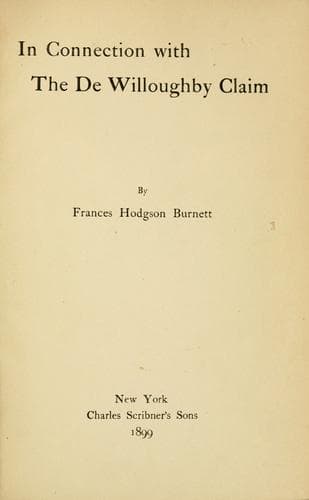
In Connection with the De Willoughby ClaimBurnett, Frances Hodgson
General
In Connection with the De Willoughby Claim
Burnett, Frances Hodgson
United States -- Social life and customs -- 19th century -- Fiction
That night, with a valise in his hand, he took his place in the stage
running towards the mountain regions of North Carolina, and from that day
forward the place knew him no more. It was as he had known it would be:
no one was very sorry to be rid of him, and even Delia's sadness was at
length toned down by the excitement of preparation for and the
festivities attendant upon her triumphant union with the most dashing De
Willoughby of the flock.
When this event occurred, Tom's wanderings had ended temporarily in the
farm-house referred to in the first chapter, and his appearance in this
remote and usually undisturbed portion of his country had created some
sensation. The news of the arrival of a stranger had spread itself abroad
and aroused a slow-growing excitement.
They were a kindly, simple people who surrounded him--hospitable,
ignorant, and curious beyond measure concerning the ways of the outside
world of which they knew so little.
In the course of time, as the first keenness of his misery wore away, Tom
began to discover the advantages of the change he had made. He no longer
need contrast himself unfavourably with his neighbours. He knew more than
they, and they found nothing in him to condemn or jeer at. To them he was
a mine of worldly knowledge. He amused them and won their hearts. His
natural indolence and lack of active ambition helped the healing of his
wounds, perhaps; and then he began to appreciate the humourous side of
his position and his old tendency to ponderous joking came back, and
assisted him to win a greater popularity than any mere practical quality
could have done.
The novelty of his _role_ was its chief attraction. He began to enjoy
and give himself up to it, and make the most of his few gifts. Life was
no longer without zest. His natural indolence increased with the size of
his great body as the years passed, and his slow whimsical humour became
his strongest characteristic. He felt it a fine point in the sarcasm of
his destiny that he should at last have become a hero and be regarded
with admiration for his conversational abilities, but he bore his honours
discreetly, and found both moral and physical comfort in them.
He insensibly adopted the habits of his neighbours; he dressed with their
primitive regard for ease; he dropped now and then into their slurring
speech, and adopted one by one their arcadian customs.
Whether the change was the better or the worse for him might easily be a
matter of opinion, and depend entirely on the standpoint from which it
was viewed. At least he lived harmlessly and had no enemy.
And so existence stood with him when the second great change in his life
took place.
CHAPTER III
Public-domain text, read in full here on John Shaqi.
Reviews
Reviews
No reviews yet
Be the first to share your thoughts on this work.
Join the Discussion
Join the discussion
Sign in to leave a comment or review.
Sign InorCreate an account