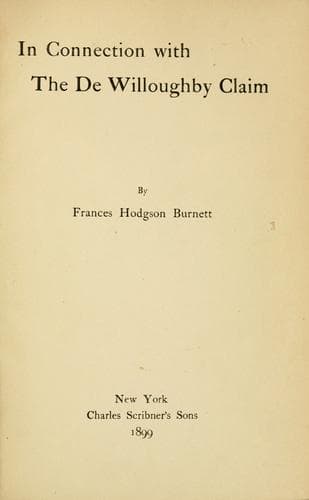
In Connection with the De Willoughby ClaimBurnett, Frances Hodgson
General
In Connection with the De Willoughby Claim
Burnett, Frances Hodgson
United States -- Social life and customs -- 19th century -- Fiction
Scarcely a month before the events described in the opening chapter took
place, the stranger and a young woman, who was his companion, had
appeared in the community. There was little that seemed mysterious about
them at the outset. A long, uninhabited cabin, a score or so of yards
from the mountain road, had been roughly patched up and taken possession
of by them. There was nothing unusual in the circumstance except that
they had appeared suddenly and entirely unheralded; but this in itself
would have awakened no special comment. The mystery developed itself from
their after reserve and seclusion. They guarded themselves from all
advances by keeping out of sight when anyone approached their cabin. The
young woman was rarely, if ever, seen. The man never called at the
post-office for mail, and upon the few occasions on which a stray human
being crossed his path, his manner was such as by no means encouraged the
curious. Mr. Stamps was the only individual who had seen the woman face
to face. There was an unmoved pertinacity in the character of Mr. Stamps
which stood him in good stead upon all occasions. He was not easily
abashed or rebuffed, the more especially when he held in view some
practical object. Possibly he held some such object in view when he rode
up to the tumbled down gateway and asked for the draught of water no
woman of the region could refuse without some reasonable excuse.
"'Tain't airs they're puttin' on, Cindy," he said to the partner of his
joys and sorrows the evening after his ride over the mountain. "Oh, no,
'tain't airs, it's somethin' more curi's than that!" And he bent over the
fire in a comfortable lounging way, rubbing his hands a little, and
blinked at the back log thoughtfully.
They were a friendly and sociable people, these mountaineers, all the
more so because the opportunities for meeting sociably were limited. The
men had their work and the women their always large families to attend
to, and with a mile or so of rough road between themselves and their
neighbours, there was not much chance for enjoyable gossip. When good
fortune threw them together they usually made the best of their time.
Consequently, the mystery of two human beings, who had shut themselves
off with apparent intent from all intercourse with their kind, was a
difficulty not readily disposed of. It was, perhaps, little to be
wondered at that Mr. Stamps thought it over and gathered carefully
together all the points presenting themselves to his notice. The subject
had been frequently discussed at the Cross-roads post-office. The
disposition to seclusion was generally spoken of as "curi'sness," and
various theories had been advanced with a view to explaining the
"curi'sness" in question. "Airs" had been suggested as a solution of the
difficulty, but as time progressed, the theory of "airs" had been
abandoned.
Public-domain text, read in full here on John Shaqi.
Reviews
Reviews
No reviews yet
Be the first to share your thoughts on this work.
Join the Discussion
Join the discussion
Sign in to leave a comment or review.
Sign InorCreate an account