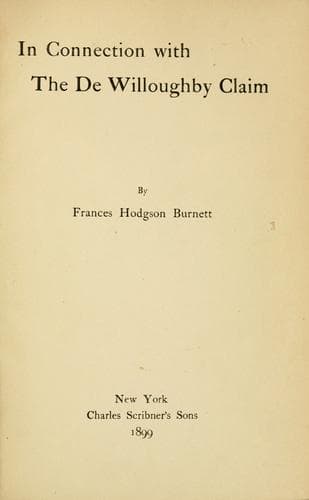
In Connection with the De Willoughby ClaimBurnett, Frances Hodgson
General
In Connection with the De Willoughby Claim
Burnett, Frances Hodgson
United States -- Social life and customs -- 19th century -- Fiction
"'Light, sonny, 'light!" he would call out in languidly sonorous tones;
"come in and let these fellows hear the news. Just throw that mail-bag on
the counter and let's hear from you. Plenty of good water down at the
spring. Might as well take that bucket and fill it if you want a drink.
I've been waiting for just such a man as you to do it. These fellows
would sit here all day and let a man die. I can't get anything out of
'em. I've about half a mind to quit sometimes and leave them to engineer
the thing themselves. Look here now, is any fellow going to attend to
that mail, or is it going to lie there till I have to get up and attend
to it myself? I reckon that's what you want. I reckon that'd just suit
you. Jehoshaphat! I guess you'd like me to take charge of the eternal
universe."
It was for the mail he waited with his usual complement of friends and
assistants on the afternoon referred to at the opening of this chapter.
The boy was behind time, and, under the influence of the heat,
conversation had at first flagged and then subsided. Big Tom himself had
taken the initiative of dropping into a doze, and his companions had one
by one followed his example, or at least made an effort at doing so. The
only one of the number who remained unmistakably awake was a little man
who sat on the floor of the end of the porch, his small legs, encased in
large blue jean pantaloons, dangling over the side. This little man, who
was gently and continuously ruminating, with brief "asides" of
expectoration, kept his eyes fixed watchfully upon the Barnesville Road,
and he it was who at last roused the dozers.
"Thar's some un a-comin'," he announced in a meek voice. "'Tain't him."
Big Tom opened his eyes, stretched himself, and gradually rose in his
might, proving a very tight fit for the establishment, especially the
doorway, towards which he lounged, supporting himself against its side.
"Who is it, Ezra?" he asked, almost extinguishing the latter cognomen
with a yawn.
"It's thet thar feller!"
All the other men awakened in a body. Whomsoever the individual might be,
he had the power to rouse them to a lively exhibition of interest. One
and all braced themselves to look at the horseman approaching along the
Barnesville Road.
"He's a kinder curi's-lookin' feller," observed one philosopher.
"Well, at a distance of half a mile, perhaps he is," said Tom. "In a
cloud of dust and the sun blazin' down on him like thunderation, I don't
know but you're right, Nath."
"Git out!" replied Nath, placidly. "He's a curi's-actin' feller, anyway.
Don't go nowhar nor hev nothin' to say to nobody. Jest sets right down in
that thar holler with his wife, as if b'ars an' painters wus all a man or
woman wanted round 'em."
"She's a doggoned purty critter," said the little man in large trousers,
placidly. He had not appeared to listen to the conversation, but, as this
pertinent remark proved, it had not been lost on him.
Public-domain text, read in full here on John Shaqi.
Reviews
Reviews
No reviews yet
Be the first to share your thoughts on this work.
Join the Discussion
Join the discussion
Sign in to leave a comment or review.
Sign InorCreate an account