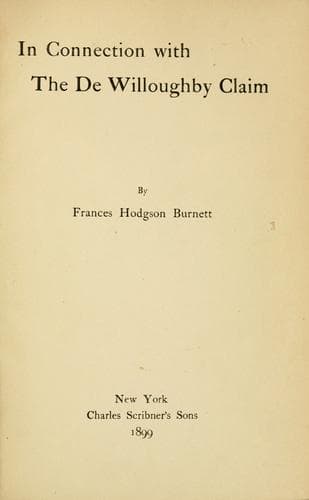
In Connection with the De Willoughby ClaimBurnett, Frances Hodgson
General
In Connection with the De Willoughby Claim
Burnett, Frances Hodgson
United States -- Social life and customs -- 19th century -- Fiction
His observation was greeted with a general laugh, which seemed to imply
that the speaker had a character which his speech sustained.
"Whar did ye see her, Stamps?" was asked.
The little man remained unmoved, still dangling his legs over the porch
side, still ruminating, still gazing with pale, blinking eyes up the
road.
"Went over the mountain to 'tend court to Bakersville, an' took it on my
road to go by thar. She was settin' in the door, an' I see her afore she
seen me. When she hearn the sound of my mule's feet, she got up an' went
into the house. It was a powerful hot mornin', 'n' I wus mighty dry, 'n'
I stopped fur a cool drink. She didn't come out when fust I hollered, 'n'
when she did come, she looked kinder skeered 'n' wouldn't talk none. Kep'
her sunbonnet over her face, like she didn't want to be seen overmuch."
"What does she look like, Ezry?" asked one of the younger men.
Mr. Stamps meditated a few seconds.
"Don't look like none o' the women folk about yere," he replied, finally.
"She ain't their kind."
"What d'ye mean by that?"
"Dunno eggsactly. She's mighty white 'n' young-lookin' 'n' delicate--but
that ain't all."
Tom made a restless movement.
"Look here, boys," he broke in, suddenly, "here's a nice business--a lot
of fellows asking questions about a woman an' gossiping as if there
wasn't a thing better to do. Leave 'em alone, if they want to be left
alone--leave 'em alone."
Mr. Stamps expectorated in an entirely unbiased manner. He seemed as
willing to leave his story alone as he had been to begin it.
"He's comin' yere," he said, softly, after a pause. "Thet's whar he's
comin'."
The rest of the company straightened themselves in their seats and made
an effort to assume the appearance of slightly interested spectators. It
became evident that Mr. Stamps was right, and that the rider was about to
dismount.
He was a man about thirty years of age, thin, narrow-chested, and
stooping. His coarse clothes seemed specially ill-suited to his slender
figure, his black hair was long, and his beard neglected; his broad hat
was pulled low over his eyes and partially concealed his face.
"He don't look none too sociable when he's nigher than half a mile,"
remarked Nath in an undertone.
He glanced neither to the right nor to the left as he strode past the
group into the store. Strange to relate, Tom had lounged behind the
counter and stood ready to attend him. He asked for a few necessary
household trifles in a low tone, and, as Tom collected and made them into
a clumsy package, he stood and looked on with his back turned towards the
door.
Those gathered upon the porch listened eagerly for the sound of
conversation, but none reached their ears. Tom moved heavily to and fro
for a few minutes, and then the parcel was handed across the counter.
"Hot weather," said the stranger, without raising his eyes.
"Yes," said Tom, "hot weather, sir."
"Good-day," said the stranger.
"Good-day," answered Tom.
Public-domain text, read in full here on John Shaqi.
Reviews
Reviews
No reviews yet
Be the first to share your thoughts on this work.
Join the Discussion
Join the discussion
Sign in to leave a comment or review.
Sign InorCreate an account