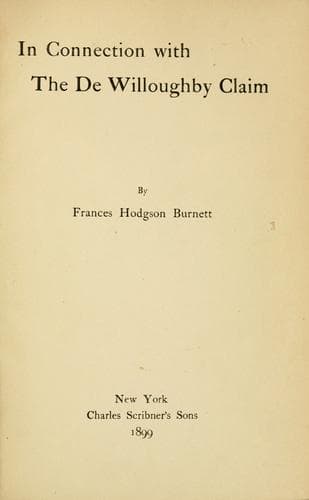
In Connection with the De Willoughby ClaimBurnett, Frances Hodgson
General
In Connection with the De Willoughby Claim
Burnett, Frances Hodgson
United States -- Social life and customs -- 19th century -- Fiction
"They didn't?" said Tom, with secretly repressed exultation. "Well, if
they didn't, I guess she'll do. They are rather nice, I reckon--and I
meant they should be. Say, Mornin, suppose you dress her up and let me
show her to the boys."
He himself picked out the sumptuous long-skirted garments she was to wear
and watched with the deepest interest the rather slow process of her
attiring. He was particularly pleased with a wonderfully embroidered
white cloak and lace cap, which latter article he abstractedly tied on
his great fist and found much too small for it. His triumph, when she was
given to his arms, he did not attempt to conceal, but carried her into
the store with the manner of a large victor bearing his spoils.
"Now look here, boys," he announced, being greeted with the usual
laughter and jocular remarks. "This ain't the style of thing we want.
Hand a man a chair."
His customary support being produced, he seated himself in it, keeping
his charge balanced with a dexterity and ease quite wonderful to behold.
"What we want," he proceeded, "is a more respectful tone. Something in
the elaborate chivalric style, and we're going to have it. What we want
is to come into this establishment feeling that there's no risk of our
being scared or upset by any durned fool startling us and setting our
delicate machinery wrong. We've come here to stay, and we expect to be
more familiar with things as we grow older, and the thing for us is to
start out right without any disagreeable impressions. We don't want to
say when we're brought in here--'Why, here's the place where that fool
gave me such a start last week. I wonder if he's here again?' What we
want is to feel that here's a place that's home, and a place that a
person's likely to look forward to coming to with the view to ah--I
should say to a high old time of an agreeable description."
"She's a-goin' to be a doggoned purty critter," said a lounger who sat on
a barrel near by.
"She ain't nuthin' like her mother," said another; "though she wus a
purty critter when I seed her."
He had only seen her in her coffin.
"She ain't like her father," put in another.
Tom moved in his chair uneasily.
"She won't be like either of them," he said. "Let that go."
There was a tone in his voice which more than one among them had now and
again noticed with some slow bewilderment during the last few weeks--a
tone new to them, but which in time they grew used to, though they never
understood its meaning.
"Kinder," they used to say, "as ef he wus mad or--ruffed up, though it
warn't that exactly, either."
"Black eyes, h'ain't she?" inquired the man on the barrel.
"Yes."
"An har. That's my kind er women, black eyes an' har, and kinder spirity.
They've more devil to 'em 'n' is better able to take care of 'emselves."
"She's got some one to take care of her," answered Tom. "That's my
business."
Public-domain text, read in full here on John Shaqi.
Reviews
Reviews
No reviews yet
Be the first to share your thoughts on this work.
Join the Discussion
Join the discussion
Sign in to leave a comment or review.
Sign InorCreate an account