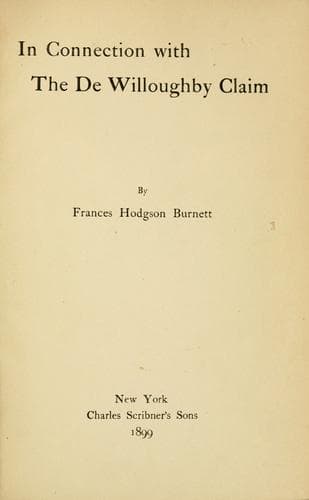
In Connection with the De Willoughby Claim — John Shaqi
In Connection with the De Willoughby ClaimBurnett, Frances Hodgson
General
In Connection with the De Willoughby Claim
Burnett, Frances Hodgson
United States -- Social life and customs -- 19th century -- Fiction
"You've got her mightily fixed up, Tom," remarked Mr. Doty, who had just
entered. "You'll hev all the women in the country flocking up. She sorter
makes me think o' the Queen o' Sheby. Sheby, she wus great on fixin'."
Every man who entered, seeing her as she lay in state in Tom's lap, was
drawn towards her to stand and wonder at her vaguely. There developed a
tendency to form small and rather silent groups about her. Infancy was no
novelty in this region of numerous progenies, but the fine softness of
raiment and delicate sumptuousness of infancy were. More than one man,
having looked at her and wandered away, was unable to resist the
temptation to wander back again and finally to settle in some seat or box
upon a barrel, that he might the better indulge his curiosity and
interest.
"Ye must hev spent a heap on her, Tom," was said respectfully again and
again.
The fact that "a heap had been spent on her" inspired the audience with a
sense of her importance, which amounted to reverence. That she
represented an apparently unaccountable expenditure, was considered to
reflect credit upon her, however vaguely, and to give her a value not to
be lightly regarded. To Mr. Doty the idea of the "Queen of Sheby"
appeared to recur persistently, all his imaginings of the poetic, the
dramatic, and luxurious being drawn from Scriptural sources.
"I can't think o' nuthin' else but Sheby when I look at her," he remarked
several times. "She 'minds me more o' Sheby then anything else 'n
Scripter. Minty'll jest hev to come ter see her."
This boldness of imagery struck a chord in the breast of his hearers
which responded at once. It was discovered that more than one of them had
been reminded in some indefinite manner of the same distinguished
personage.
"When she was consider'ble younger then in Solomon's time," said one
gentleman with much solemnity.
Tom himself was caught by the fancy and when his charge was referred to
occasionally in a most friendly spirit as "Sheby thar," he made no
protest against it.
"It's a thunderation sight better than 'Flishyer,'" he said, "and if it
comes easier to you fellows, I've no objection. Sheba ain't bad. There's
a kind of swing to it, and you can't get it very far wrong. The other's a
good name spoiled, and it's a name I've a fancy for saving for her. I
gave it to her--I'll save it for her, and it shall be a thing between us
two. Call her Sheba if you like."
So it fell out that Mr. Doty's Oriental imaginings sealed her fate and
gradually, by a natural process, Felicia was abandoned for Sheba, even
Tom using it upon all ordinary occasions.
Having in this manner begun life, a day rarely passed in which she did
not spend an hour or so in the post-office. Each afternoon during the
first few months of her existence Tom brought her forth attired in all
her broidery, and it was not long before the day came when he began to
cherish the fancy that she knew when the time for her visit was near, and
enjoyed it when it came.
Public-domain text, read in full here on John Shaqi.
Reviews
Reviews
No reviews yet
Be the first to share your thoughts on this work.
Join the Discussion
Join the discussion
Sign in to leave a comment or review.
Sign InorCreate an account