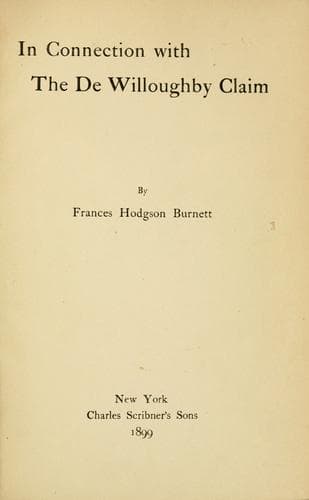
In Connection with the De Willoughby ClaimBurnett, Frances Hodgson
General
In Connection with the De Willoughby Claim
Burnett, Frances Hodgson
United States -- Social life and customs -- 19th century -- Fiction
Mrs. Marvin simply followed the direction his eyes had taken. She was a
practical person. The object her eye met was the figure of the boy who
had come in a few minutes before. He was leaning against the doorpost,
attired in a cool suit of white linen, his hands in his pockets, the
expression of his handsome darkling young face a most curious one. He was
staring at his father steadily, his fine eyes wide open holding a spark
of inward rage, his nostrils dilated and quivering. He seemed bent upon
making the orator meet his glance, but the orator showed no desire to do
so. He gave his sole attention to his glass of water. To this clever,
elderly Southern matron it was an interesting scene.
"If he sprang up in two minutes and threw something deadly and murderous
at him," she said to herself, "I should not be in the least surprised;
and I should not be the first to blame him."
But the rest of the audience was intent upon the Colonel, who, recovering
himself, finished his harangue with an appeal that the land made sacred
by those loves, those homes, those graves, might be left solely in the
hands of the men who loved it best, who knew its needs, who yearned for
its highest development, and who, when the needful hour arrived, would
lay down their lives to save its honour.
When he concluded, and was on the point of seating himself very quietly,
without any appearance of being conscious of the great sensation he had
created, and still wearing an admirable touch of melancholy upon his fine
countenance, Major Beaufort rushed towards him, almost upsetting a chair
in his eagerness, and grasped his hand and shook it with a congratulatory
ardour so impressive and enthusiastic as to be a sensation in itself.
There were other speeches afterwards. Fired by the example of his friend,
Major Beaufort distinguished himself by an harangue overflowing with
gallantry and adorned throughout with amiable allusions to the greatest
power of all, the power of Youth, Beauty, and Womanhood. The political
perspicuity of the address was perhaps somewhat obscured by its being
chivalrously pointed towards those fair beings who brighten our existence
and lengthen our griefs. Without the Ladies, the speaker found, we may be
politicians, but we cannot be gentlemen. He discovered (upon the spot,
and with a delicate suggestion of pathos) that by a curious coincidence,
the Ladies were the men's mothers, their wives, their sisters, their
daughters. This being greatly applauded, he added that over these
husbands, these fathers, these brothers--and might be added "these
lovers"--the Ladies wielded a mighty influence. The position of Woman,
even in the darkest ages, had been the position of one whose delicate
hand worked the lever of the world; but to-day, in these more enlightened
times, in the age of advancement and discovery, before what great and
sublime power did the nobleman, the inventor, the literary man, the
warrior, bow, as he bowed before the shrine of the Ladies?
Public-domain text, read in full here on John Shaqi.
Reviews
Reviews
No reviews yet
Be the first to share your thoughts on this work.
Join the Discussion
Join the discussion
Sign in to leave a comment or review.
Sign InorCreate an account