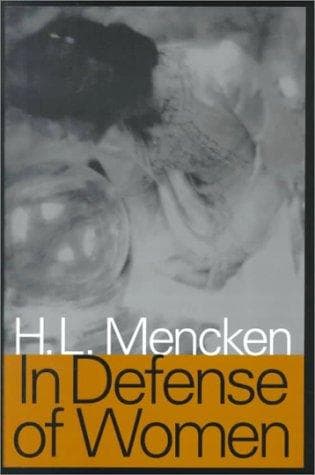
Sexism; Women -- Social and moral questions; Women -- Social conditions
Turn, for example, to the field in which the two sexes come most
constantly into conflict, and in which, as a result, their habits of
mind are most clearly contrasted—to the field, to wit, of monogamous
marriage. Surely no long argument is needed to demonstrate the superior
competence and effectiveness of women here, and therewith their greater
self-possession, their saner weighing of considerations, their higher
power of resisting emotional suggestion. The very fact that marriages
occur at all is a proof, indeed, that they are more cool-headed than
men, and more adept in employing their intellectual resources, for it
is plainly to a man’s interest to avoid marriage as long as possible,
and as plainly to a woman’s interest to make a favourable marriage as
soon as she can. The efforts of the two sexes are thus directed, in one
of the capital concerns of life, to diametrically antagonistic ends.
Which side commonly prevails? I leave the verdict to the jury. All
normal men fight the thing off; some men are successful for relatively
long periods; a few extraordinarily intelligent and courageous men (or
perhaps lucky ones) escape altogether. But, taking one generation with
another, as every one knows, the average man is duly married and the
average woman gets a husband. Thus the great majority of women, in this
clear-cut and endless conflict, make manifest their substantial
superiority to the great majority of men.
Not many men, worthy of the name, gain anything of net value by
marriage, at least as the institution is now met with in Christendom.
Even assessing its benefits at their most inflated worth, they are
plainly overborne by crushing disadvantages. When a man marries it is
no more than a sign that the feminine talent for persuasion and
intimidation—i.e., the feminine talent for survival in a world of
clashing concepts and desires, the feminine competence and
intelligence—has forced him into a more or less abhorrent compromise
with his own honest inclinations and best interests. Whether that
compromise be a sign of his relative stupidity or of his relative
cowardice it is all one: the two things, in their symptoms and effects,
are almost identical. In the first case he marries because he has been
clearly bowled over in a combat of wits; in the second he resigns
himself to marriage as the safest form of liaison. In both cases his
inherent sentimentality is the chief weapon in the hand of his
opponent. It makes him cherish the fiction of his enterprise, and even
of his daring, in the midst of the most crude and obvious operations
against him. It makes him accept as real the bold play-acting that
women always excel at, and at no time more than when stalking a man. It
makes him, above all, see a glamour of romance in a transaction which,
even at its best, contains almost as much gross trafficking, at bottom,
as the sale of a mule.
Public-domain text, read in full here on John Shaqi.
Reviews
Reviews
No reviews yet
Be the first to share your thoughts on this work.
Join the Discussion
Join the discussion
Sign in to leave a comment or review.
Sign InorCreate an account