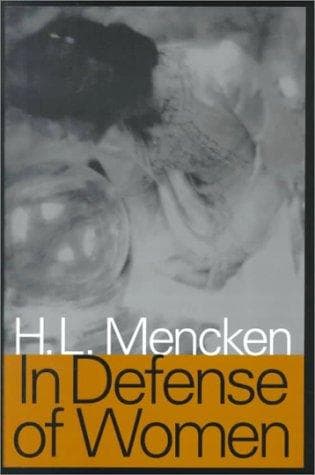
Sexism; Women -- Social and moral questions; Women -- Social conditions
A man in full possession of the modest faculties that nature commonly
apportions to him is at least far enough above idiocy to realize that
marriage is a bargain in which he gets the worse of it, even when, in
some detail or other, he makes a visible gain. He never, I believe,
wants all that the thing offers and implies. He wants, at most, no more
than certain parts. He may desire, let us say, a housekeeper to protect
his goods and entertain his friends—but he may shrink from the thought
of sharing his bathtub with anyone, and home cooking may be downright
poisonous to him. He may yearn for a son to pray at his tomb—and yet
suffer acutely at the mere approach of relatives-in-law. He may dream
of a beautiful and complaisant mistress, less exigent and mercurial
than any a bachelor may hope to discover—and stand aghast at admitting
her to his bank-book, his family-tree and his secret ambitions. He may
want company and not intimacy, or intimacy and not company. He may want
a cook and not a partner in his business, or a partner in his business
and not a cook. But in order to get the precise thing or things that he
wants, he has to take a lot of other things that he doesn’t want—that
no sane man, in truth, could imaginably want—and it is to the
enterprise of forcing him into this almost Armenian bargain that the
woman of his “choice” addresses herself. Once the game is fairly set,
she searches out his weaknesses with the utmost delicacy and accuracy,
and plays upon them with all her superior resources. He carries a
handicap from the start. His sentimental and unintelligent belief in
theories that she knows quite well are not true—e.g., the theory that
she shrinks from him, and is modestly appalled by the banal carnalities
of marriage itself—gives her a weapon against him which she drives home
with instinctive and compelling art. The moment she discerns this
sentimentality bubbling within him—that is, the moment his oafish
smirks and eye rollings signify that he has achieved the intellectual
disaster that is called falling in love—he is hers to do with as she
will. Save for acts of God, he is forthwith as good as married.
7. The Feminine Attitude
Public-domain text, read in full here on John Shaqi.
Reviews
Reviews
No reviews yet
Be the first to share your thoughts on this work.
Join the Discussion
Join the discussion
Sign in to leave a comment or review.
Sign InorCreate an account