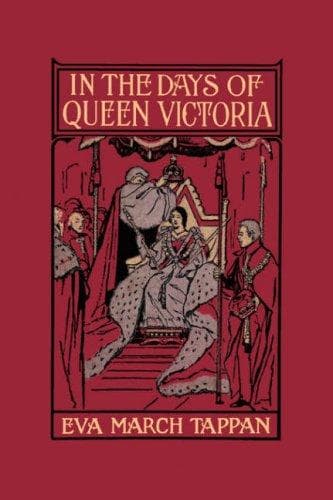
Great Britain -- History -- Victoria, 1837-1901 -- Fiction
It was decided, then, that the Duchess would remain in England, and
that Kensington Palace should become the home of the Princess
Alexandrina Victoria. This was a large, comfortable-looking abode. It
had been a favorite home of several of the English sovereigns. About it
were gardens cut into beds shaped like scrolls, palm leaves, ovals,
circles, and all sorts of conventional figures so prim and stiff that
one might well have wondered how flowers ever dared to grow in any
shape but rectangular. The yew trees were trimmed into peacocks and
lions and other kinds of birds and beasts. All this was interesting
only as a curiosity, but there was a pretty pond and there were long,
beautiful avenues of trees. There were flowers and shrubs and soft
green turf. It was out of the fog and smoke of the city; indeed it was
so far out that there was danger of robbers to the man who ventured to
walk or drive at night through the unlighted roads. For many years
after the birth of the Princess a bell was rung Sunday evenings so that
all Londoners might meet and guard against danger by going over the
lonely way to their homes in one large company.
The life at Kensington was very quiet. No one would have guessed from
seeing the royal baby that the fate which lay before her was different
from that to be expected for any other child who was not the daughter
of a Prince. She spent much of the time out of doors, at first in the
arms of her nurse, then in a tiny carriage, in which her half-sister,
the Princess Feodore, liked to draw her about. "She must learn never to
be afraid of people," declared the wise mother, and before the child
could speak plainly she was taught to make a little bow when strangers
came near her carriage and say, "Morning, lady," or "Morning, sir."
The little girl was happy, but life was hard for the mother. She had
given up her home and her friends, and now she had to give up even her
own language, for English and not German must be her child's mother
tongue, and she set to work bravely to conquer the mysteries of English
Her greatest comfort in her loneliness was the company of the Duchess
Adelaide, wife of the Duke of Clarence. For many weeks after the death
of the Duke of Kent, the Duchess drove to Kensington every day to spend
some time with her sister-in-law. When the Princess was about a year
and a half old, a little daughter was born to the Duchess Adelaide, but
in three months she was again childless. She had none of the royal
brothers' jealousy of the baby at Kensington, and she wrote to the
Duchess of Kent, "My little girls are dead, but your child lives, and
she shall be mine, too."
CHAPTER II
THE SCHOOLDAYS OF A PRINCESS
Public-domain text, read in full here on John Shaqi.
Reviews
Reviews
No reviews yet
Be the first to share your thoughts on this work.
Join the Discussion
Join the discussion
Sign in to leave a comment or review.
Sign InorCreate an account