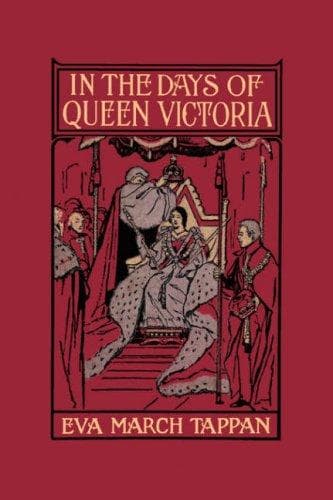
Great Britain -- History -- Victoria, 1837-1901 -- Fiction
"She is called Lyra," said the Duchess. "Should you like to hear her
play?"
The Princess was very fond of music even when she was hardly more than
a baby, and she could scarcely wait for the day to come when she could
hear the little girl. At last Lyra and her harp were brought to the
palace, and the music began. The talented child played piece after
piece, then she stopped a moment to rest. This was the Princess'
opportunity. Music was good, but a real little girl was a great rarity,
and the small hostess began a conversation.
"Does your doll have a red dress?" she asked. "Mine has, and she has a
bonnet with swans-down on it. Does yours have a bonnet?"
"I haven't any doll," answered Lyra.
"Haven't you any playroom?" asked the Princess wonderingly.
"No," said the little musician.
The Princess had supposed that all children had dolls and toys, and she
said: "I have a playroom upstairs, and there are dolls in it and a
house for them and a big, big ship like the one my papa sailed in once.
Haven't you any ship or any doll-house?"
"No."
"Haven't you any sister Feodore?"
"No."
Then the warm-hearted little Princess threw her arm around the child
musician and said:
"Come over here to the rug, and let's play. You shall have some of my
playthings, and perhaps your mamma will make you a doll-house when you
go home."
The Duchess had left the two children for a few minutes, and when she
returned they were sitting on the fur rug in front of the fire. The
harp was forgotten, and they were having a delightful time playing
dolls, just as if they were not the one a princess and the other a
musical prodigy. They were too busy to notice the Duchess, and as she
stood at the door a moment, she heard her little daughter saying:
"You may have the doll to take home with you, Lyra. Put on her red
dress and her white bonnet and her cloak, for she'll be ill if you
don't. Her name is Adelaide, for that is my aunt's name."
The Princess was not yet four years old, but her mother was beginning
to feel somewhat anxious about her education. Other children might
play, but the child who was to be queen of England must not be allowed
to give even her babyhood to amusement. The mother began to teach her
the alphabet, but the little girl had a very decided will of her own,
and she did not wish to learn the alphabet.
"But you will never be able to read books as I do, if you do not
learn," said the mother.
"Then I'll learn," promised the child. "I'll learn very quick."
The alphabet was learned, but the resolutions of three-year old
children do not always endure, and the small student objected to
further study.
Public-domain text, read in full here on John Shaqi.
Reviews
Reviews
No reviews yet
Be the first to share your thoughts on this work.
Join the Discussion
Join the discussion
Sign in to leave a comment or review.
Sign InorCreate an account