In the Line of Battle: Soldiers' Stories of the War — John Shaqi
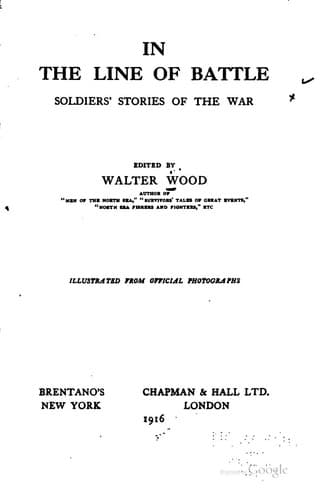
In the Line of Battle: Soldiers' Stories of the War
History
In the Line of Battle: Soldiers' Stories of the War
World War, 1914-1918 -- Personal narratives
The following statement will show exactly how and when we were fed each
day:--In the morning, at six o’clock, we had “coffee,” made from burnt
rye, but nothing to eat; at twelve noon, soup, with a plentiful supply
of water in it and any one of the following ingredients: chestnuts,
potatoes, horse beans, sauerkraut, acorns. At 12.30 to 1 p.m. there
was an issue of bread, the loaves being about 2½ in. by 6 in. by 2 in.
At 3 p.m. there was “coffee,” as at 6 a.m., but nothing to eat; and at
6 p.m. there was soup, as for dinner, but no meat, fish or cheese. By
this you will see that we had nothing to eat from 6 p.m. till noon the
following day--a period of eighteen hours. We had a small piece of meat
three times a fortnight, cheese once a week, and two raw herrings a
week.
As for passing the time, it was one long dreary “roll on, night.”
Cards, draughts, football, and causing as much trouble as we dared to
the Germans, with a little singing, formed our only means of keeping
sane. Nearly everybody had to work at something or other, the hours of
work being 7 a.m. to 11.30 a.m. (empty stomachs), and 2 p.m. to 6 p.m.
There was only one occasion when we had a little change from the bad
treatment, and that was when a batch of German prisoners of war, who
had been in England and exchanged, returned. They must have told how
splendidly they were treated in English hospitals--which, as I know,
are paradise compared with German hospitals--for we were better fed and
looked after for a time. This improvement did not last long, however,
and we went back to the old ways. Germans can’t keep a good thing going.
German cunning and lying soon made themselves evident, for under the
guise of voluntary work a lot of the prisoners of war were obliged to
work in mines and ironworks, and by being forced to do these things
they were really helping to fight their own people.
The way the trick was done was this--Germans came round and asked
prisoners to volunteer to act as waiters, and a lot of us readily
agreed, because any sort of employment was better than awful idleness.
But the “waiters” soon learned that they had been shamefully deceived,
for they were sent into mines and ironworks and on to farms. It was no
use to protest, because it was a case of work or no food. There was
so little to eat in the ordinary way that poor fellows could not face
actual starvation, and so they worked unwillingly. I was asked to go
and work in the fields, but I was quite incapable of doing this, and so
I told the camp commandant, who put me into the office.
I had had experience of orderly-room work with the Guards, and felt
quite at home at this job--and it was interesting, too, for I was in
the extraordinary position of being a sort of censor!
Public-domain text, read in full here on John Shaqi.
Reviews
Reviews
No reviews yet
Be the first to share your thoughts on this work.
Join the Discussion
Join the discussion
Sign in to leave a comment or review.
Sign InorCreate an account