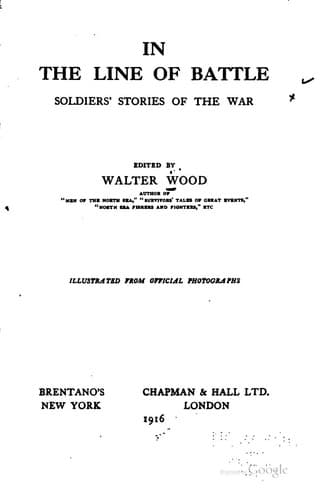
In the Line of Battle: Soldiers' Stories of the War — John Shaqi
In the Line of Battle: Soldiers' Stories of the War
History
In the Line of Battle: Soldiers' Stories of the War
World War, 1914-1918 -- Personal narratives
My duty was to handle letters from England for the prisoners, and see
that no news, or cuttings from newspapers, or other forbidden things
got through. There were three of us doing this work--two sergeants
and myself, one sergeant being in charge of the parcels. I naturally
did the best I could for the prisoners. This office work was both
interesting and exciting, and helped to get the time along.
As for our privations generally, there was nothing for it but to
make the best of them and grin and bear it. The American Consul at
Münster paid two visits to the camp while I was there, but no good
came of them. Again the crafty German was prepared. It was known on
each occasion that the Consul was coming--known two days before he
arrived--so things were ready for him. He inspected only a few of the
rooms, and the principal result of the first visit was that our dinner
was two hours late. We made complaints, but nothing came of them, so
when the Consul visited us for the second time and asked if there were
any complaints to make, we bluntly answered, “No, it’s no good making
them, for nothing’s done.” The Germans instantly published in the
local paper the statement, “The English are satisfied. They have no
complaints.”
Constant attempts were made to escape, and I fancy that some of the
prisoners gave up the whole of their time to plotting and planning
ways of clearing out. The chance of getting away was small, because
at night the camp, buildings as well as compounds, was brilliantly
lighted by big electric arc lamps, and there were sentries and barbed
wire entanglements everywhere. But in spite of all precautions several
Belgians and a few Englishmen and Frenchmen escaped, and we were
immensely pleased when we heard that one Belgian had got away by
stealing the commandant’s motor-car and bolting in it. I did not hear
what became of him.
Brutal punishments were inflicted for the most trivial offences, such
as smoking in forbidden places, and a common method was to tie a
prisoner to a post, with his feet deep in snow, and leave him there
for two hours, with an armed sentry over him. The poor wretch dare not
move, if he did the brave warrior with the gun kicked him--the German
is a fine hand at hitting when the other chap can’t hit back. This
savage cruelty had a terrible effect on some of the victims, and helped
to make them the life-long wrecks that they now are.
From Münster I was sent to Brussels for exchange. We were quartered in
the Royal Academy, and naturally enough the Belgian women and children
tried to give us things. When this was seen, the German wounded who
were in the building were ordered to turn the hose on, and they did.
It was a great laugh, though, for it took them four hours to fix the
hose--and then it would not work properly.
Public-domain text, read in full here on John Shaqi.
Reviews
Reviews
No reviews yet
Be the first to share your thoughts on this work.
Join the Discussion
Join the discussion
Sign in to leave a comment or review.
Sign InorCreate an account