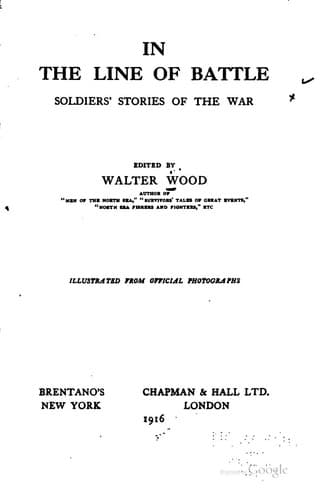
In the Line of Battle: Soldiers' Stories of the War
History
In the Line of Battle: Soldiers' Stories of the War
World War, 1914-1918 -- Personal narratives
There was a fine smart affair on the night of April 17th, when about
a mile of German trenches was taken, and I saw about 2000 German
prisoners being escorted away. Their uniforms were shabby, and their
equipment was not what it ought to have been, but the men themselves
appeared to be remarkably fit and well cared for.
We had gone into the trenches after marching through Ypres, where the
chimney-pots were tumbling about our ears, and we were expecting very
hot times; but the hogback prevented us from seeing the Germans, and
of course kept us out of their sight. But there were German snipers
everywhere, and they took good care to harass us.
I had charge of a section of bomb-throwers, and we did our best to
hurl these strange but quite legitimate weapons at the enemy. At first
the bombs were homely contrivances, made of jam-tins filled with
explosives; but later they were made under War Office control, and were
far superior to the primitive articles which we manufactured ourselves.
In such a war and in such a place it is not easy to tell of what was
done by individuals, because so many splendid acts are unobserved; but
I call to mind the coolness and resource of my own platoon officer,
Lieutenant McLeod. He was dashing all over the place, encouraging his
men at every point, and doing things all round in fine style. I was
talking to him quite a lot in the thick of things, and was specially
struck by his calmness and the wonderful effect his example had upon
the men.
One outstanding performance of his was to run, in broad daylight, from
battalion headquarters to the trenches--a pretty brave achievement,
when you bear in mind that a running man presents an almost certain
target to snipers.
In this connection, I call to mind the case of a section commander who
was in a trench. He wished that a certain thing should be done, and by
way of indicating his desire he held up his hand, with palm extended.
That must have been a small enough target, in all conscience, but it
was no sooner in the air than it was pierced by five German bullets.
If a hand can be so effectively fired at, what chance to escape has the
body of a man?
This trench warfare was uncommonly exhausting. You never knew what was
going to happen, or what you would be called upon to do; but it was
astonishing to find how soon you could adapt yourself to circumstances.
Public-domain text, read in full here on John Shaqi.
Reviews
Reviews
No reviews yet
Be the first to share your thoughts on this work.
Join the Discussion
Join the discussion
Sign in to leave a comment or review.
Sign InorCreate an account