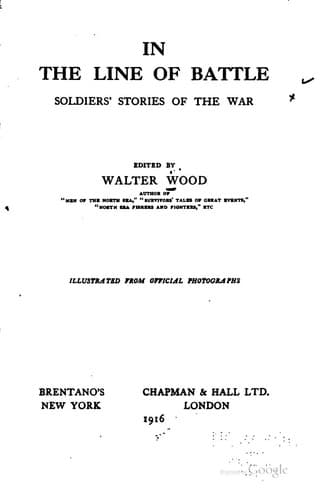
In the Line of Battle: Soldiers' Stories of the War
History
In the Line of Battle: Soldiers' Stories of the War
World War, 1914-1918 -- Personal narratives
[When the Germans plunged the civilised world into this appalling
war, one of their big hopes was that the sons of the Motherland would
desert her in the hour of her greatest need. Never was a greater
miscalculation made, even in a war which has become notorious for
enemy miscalculations, for her Colonies rallied round Great Britain
in a manner that has covered them with lasting glory. A particularly
splendid contingent hurried over from Canada to our shores, and went
into the most severe training, lasting through an uncommonly bad
winter. In due course it left England, and entered almost at once into
some of the hardest and most deadly fighting of the whole campaign--the
conflict at the village of St. Julien, in the region of the famous Hill
60, where many troops fell gloriously in repelling the attempts of the
Germans to hack their way through to Calais. In their determination
to succeed, the Germans deliberately adopted the devilish device of
poison-gas. How even that cowardly expedient failed is told in this
story by Lance-Corporal R. G. Simmins, of the 8th Battalion Canadian
Infantry, 90th Winnipeg Rifles.]
When I recall my experiences at the front, I am particularly struck by
the circumstance that the thing which stands out most clearly in my
mind is not the actual campaigning, not the long and weary times in the
trenches, not even artillery, rifle, or bayonet work, but the coming
of the poison-gas. I myself was gassed in the furious fighting at St.
Julien.
I will get right at things quickly. Towards the end of April the
Canadian Division was holding a line near Ypres, which was not far
short of three miles in extent. That line ran north-west from
Poelcapelle-Paschendaile Road, and at the end joined up with the
French. Three infantry brigades with artillery comprised the division,
the first being in reserve, the second on the right of the third, and
the third connecting with the French.
We were in the salient of Ypres which was known to be weak, but the
holding of which was of vast importance. I am proud to think that I am
one of the Canadian Contingent to whom the big task of keeping back the
German hosts at that point was given, and that I fought with men who
gave their lives in stopping the German attempt to hack a way through
to Calais, so as to have a very near blow at England. Placed as we were
placed, it was possible to see the battle being fought on three sides,
and this was uncommonly interesting.
We were, of course, in trenches, quite near the Germans, but between
us there ran a ridge which is known as a hogback, so that there was a
somewhat formidable natural barrier between the opposing forces. We
were so near to the famous Hill 60 that we heard the explosion there
and the subsequent battle when we were in billets at Ypres. The hill
had been mined with six or seven tons of dynamite, the explosion of
which was enough to change even the appearance of the hill.
Public-domain text, read in full here on John Shaqi.
Reviews
Reviews
No reviews yet
Be the first to share your thoughts on this work.
Join the Discussion
Join the discussion
Sign in to leave a comment or review.
Sign InorCreate an account