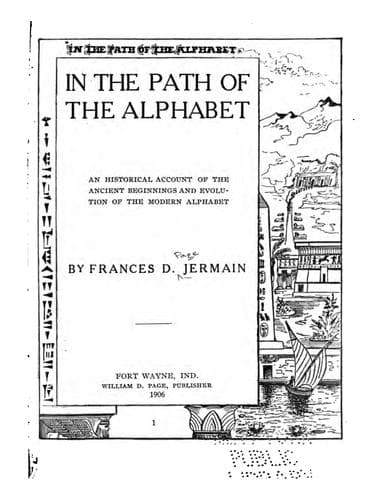
In the path of the alphabet: an historical account of the ancient beginnings and evolution of the modern alphabetJermain, Frances Delavan Page
History
In the path of the alphabet: an historical account of the ancient beginnings and evolution of the modern alphabet
Jermain, Frances Delavan Page
Alphabet
The selection of a number of such signs representing initial syllables
of words is termed a syllabary. Its formation occurred when all, or a
greater part, of the unions of single consonants with vowel sounds in a
language had received each its phonetic and characteristic sign and was
thus used independently of any previous signification of the word from
which it was derived.
Selections of these signs could be used almost as the alphabet is used
to form words. That they were not entirely depended upon by many
intelligent nations that possessed a syllabary is one of the curiosities
in the history of written speech.
The influence of the syllabaries which developed under different
conditions in various languages is an exceedingly interesting study,
sometimes so increasing the simplicities of written speech as to nearly
approach the powers of the alphabet; again, increasing the extraordinary
complexities writing had assumed at the syllabic stage.
Thus these syllabaries have been at once the despair and the
illumination of scholars, who, attempting to decipher these unknown
characters as letters, could make nothing of them, but when finally
recognizing their syllabic values, a wonderful period in the history of
letters was revealed.
Syllabic systems, wherever found, are a study of special significance;
so nearly alphabetic, yet so remote; always suggesting the greater
simplicities to be, and yet so oblivious of these simplicities.
But one step further and alphabetism is at hand. Instead of the use of
the sign for the phonetic power of the syllable, the use of this sign
for the phonetic power of the letter was all that was necessary.
To many nations such an advance was inconceivable. For this, the
conception of the elementary sounds of which words are composed is
necessary; the vowels and the consonants, the consonant being the chief
power in this development.
It has been suggested that this advance when reached was the result of
the prominence of the consonant in the syllable. For instance, the
phonetic power of the consonant in the syllables sa, se, si, so, su, is
constant while the vowels are variable.
The consonants thus appeared to be the substantial elements of words
while the vowels were complementary and inconstant. In this way the sign
for the syllable came finally to be the sign for the consonant, with the
vowel understood. In confirmation of this we find that the first
appearance of alphabetic writing—that is where letters only are used for
the formation of words—was consonant writing. The earliest, nearest
approach to a pure alphabet, was an alphabet of consonants.
The Semitic languages differ from all other idioms in structure. The
original roots of Semitic words are tri-consonantal, consisting of three
consonants.
Public-domain text, read in full here on John Shaqi.
Reviews
Reviews
No reviews yet
Be the first to share your thoughts on this work.
Join the Discussion
Join the discussion
Sign in to leave a comment or review.
Sign InorCreate an account