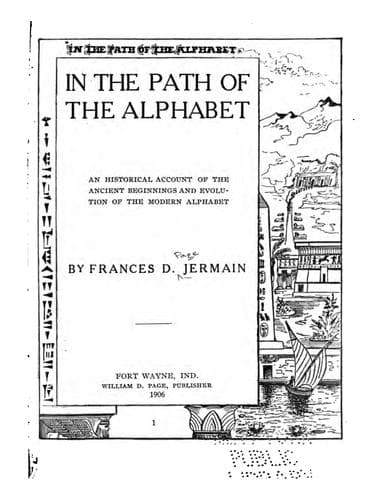
In the path of the alphabet: an historical account of the ancient beginnings and evolution of the modern alphabet — John Shaqi
In the path of the alphabet: an historical account of the ancient beginnings and evolution of the modern alphabetJermain, Frances Delavan Page
History
In the path of the alphabet: an historical account of the ancient beginnings and evolution of the modern alphabet
Jermain, Frances Delavan Page
Alphabet
These conditions have had their influence on the development of graphic
systems. In the simplest combination of a consonant and vowel, as _sa_,
_se_, _si_, _so_, _su_, if the combining power is only one way and never
another, as _as_, _es_, _is_, _os_, _us_, the number of syllables that
can be formed in such a language are few, and the number of signs to
express these are consequently limited. But when the combining power is
both ways, the number of possible syllables increases with every
increase of these combinations of vowels and consonants, and the number
of signs correspondingly.
The transmission of the Chinese system of writing to the Japanese, which
occurred about the third century, B. C., indicates this influence of
language structure towards simplicity. The Japanese language is
polysyllabic. No syllable contains more than one vowel, with a single
preceding consonant.
In the adoption by the Japanese of the Chinese characters in the
Ka-ta-ka-na syllabary, a certain number of phonograms were selected
which would give the sound of the unions of consonants and vowels in the
Japanese language. As spoken, this includes five vowels and fifteen
consonants. As these combine only in one way there are but seventy-five
possible combinations of vowels and consonants in this language. As some
of these possible combinations never occur, the use of forty-five of
these syllabic signs are all that is necessary to form any word in the
Japanese language, with the Ka-ta-ka-na syllabary.
In the formation of this syllabary the ideographic characters of the
Chinese system were found unnecessary and were rejected. The result has
been one of the best syllabaries that has ever been constructed.
The Japanese have another syllabary, the Hi-ra-ka-na, derived from a
cursive script of the Chinese. This syllabary, however, is more
complicated, including with the syllabics a greater number of signs as
variants, and homophones, in all nearly three hundred; a marked contrast
to the simplicity of the other. It is, however, one among the many
instances we have in the evolution of letters, where the simpler way
seems so easy and evident, but yet is not recognized.
------------------------------------------------------------------------
FROM THE METROPOLITAN MUSEUM OF ART, NEW YORK CITY
[Illustration]
TRANSLATION OF INSCRIPTION ON ANCIENT EGYPTIAN TABLET
Lines 1 and 2 read in the original from right to left! Below
lines 1 and 2 the god Osiris is represented as sitting on his
throne, and the inscription of these two lines refers to him.
Below lines 8 and 9 we find Amen-neb, the dedicator of the
tablet, kneeling, and below line 11 his wife Hûi kneels.
Public-domain text, read in full here on John Shaqi.
Reviews
Reviews
No reviews yet
Be the first to share your thoughts on this work.
Join the Discussion
Join the discussion
Sign in to leave a comment or review.
Sign InorCreate an account