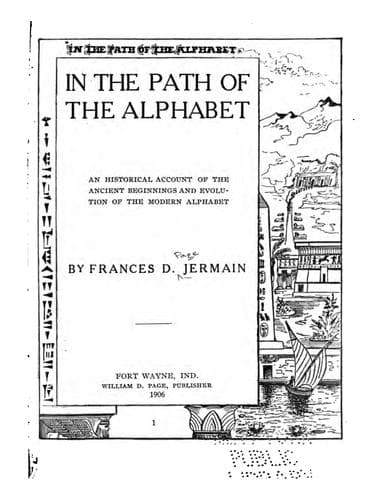
In the path of the alphabet: an historical account of the ancient beginnings and evolution of the modern alphabetJermain, Frances Delavan Page
History
In the path of the alphabet: an historical account of the ancient beginnings and evolution of the modern alphabet
Jermain, Frances Delavan Page
Alphabet
Transcription: (1) Usar heq zeta nuter â (2) suten ânxu (3) mer
ârât en Amen Amen-neb zedef (4) anez hirek qa amenti heq nefer
(5) neb zeta iu ena xerek (6) seka-ut sûshu (7) nefer-uk duk
hotepa (8) em ast ent neheh set hesu (9) amen hâti-a nen ger
(10) amef (11) himtef nebt per mertef Hui zed nes.
Translation: (1) [This is] Osiris, the god of eternity, the
great god, (2) The King of the living. (3) The chief of the
store-house of Amen, Amen-neb says: (4) Hail to thee, ruler
[literally: ‘bull’] of the Lower World, gracious god, (5) lord
of eternity, let me come before thee, (6) let me extol in praise
(7) thy beauty. Give me peace (8) in the abode of eternity, in
the country of praise [i. e. Hades] (9) that will hide my heart.
There is no de- (10) ceit in it [i. e. the heart]. (11) His
wife, mistress of his house, his beloved, Hui, she [also]
repeats [this prayer].
------------------------------------------------------------------------
CHAPTER V.
THE path of our alphabet seems to be taking us far afield when we turn
to Chinese systems of writing and to the origin and development of
cuneiform. Nevertheless, it is in this course that some of the richest
developments have appeared and the greatest rewards have been obtained
by scholars in this special direction of research.
In the narrative given of the decipherment of cuneiform writing
reference was made to the three distinct combinations of the
arrow-headed or wedge-shaped characters in the trilingual inscriptions
at first deciphered.
It was found that these three distinct combinations of cuneiform signs
represented three languages of three distinct races of men, the
Persian, an Aryan people speaking an inflectional language; the
Assyro-Babylonians, Semitic people who spoke a language related to the
Hebrew, and the third a Turanian people who spoke an agglutinative
language, allied to that of the modern Turks or Finns.
It was some time after the decipherment of the Persian version of the
cuneiform texts before these facts became fully understood. The Semitic
text presented unusual difficulties, while the language of the other
version remained for a time unknown.
The discoveries of Mr. Layard, shortly after, on the site of ancient
Nineveh, were to throw more light upon the subject.
With the unearthing of the royal palace of Assur-bani-pal, at Keyunji,
the remains of the great library founded by this monarch were discovered
beneath the ruins.
These remains consisted of more than twenty thousand bricks, tablets and
cylinders, some of which were in fragments, but a greater part entire,
and the inscriptions thereon as distinct as when first impressed in the
soft clay.
Public-domain text, read in full here on John Shaqi.
Reviews
Reviews
No reviews yet
Be the first to share your thoughts on this work.
Join the Discussion
Join the discussion
Sign in to leave a comment or review.
Sign InorCreate an account