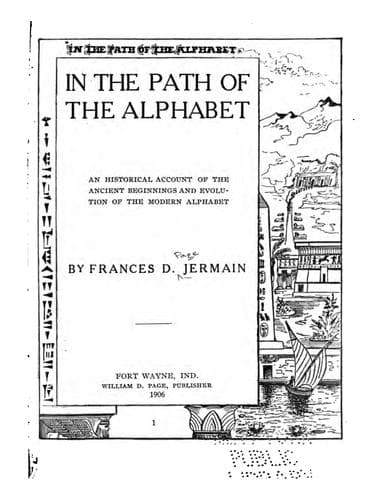
In the path of the alphabet: an historical account of the ancient beginnings and evolution of the modern alphabetJermain, Frances Delavan Page
History
In the path of the alphabet: an historical account of the ancient beginnings and evolution of the modern alphabet
Jermain, Frances Delavan Page
Alphabet
This was a fine, tenacious clay of the region which had been moulded
into bricks and cylinders of various sizes, upon which when moist the
cuneiform letters had been impressed by a wooden or metal stylus. They
had then, for the greater part, been hardened by a slow fire, and were
thus made practically indestructible. These cuneiform books were soon
distributed in the great libraries and museums of Europe, and thus
became accessible to scholars.
Among these literary documents were found a large number which consisted
of translations, either interlinear or in parallel passages, from a
non-Semitic language into Assyro-Babylonian.
It appeared in two dialects, the speech of the early people of northern
Babylonia—the people of Accad—and the speech of the primitive
inhabitants of southern Babylonia—the people of Sumir or Shinar.
The close alliance of the peoples of Accad and Sumir in race and
language has led to the general application of the name of Accadians to
both families. A closer distinction in general terms now adopted by
scholars is Sumerian.
Further discoveries rapidly following the unearthing of the Ninevite
tablets, confirmed the evidences that these people were the inventors of
cuneiform, and that the Sumerian dialect represented the most ancient of
the cuneiform scripts.
In the oldest inscriptions which have yet been found the characters are
hardly as yet cuneiform. The lines are straight and simple, resembling
somewhat the strokes and dashes appearing in words spelled by the
electric telegraphic code.
The arrangement of these is pictorial, forming picture hieroglyphics,
and these were found to be ideographic and not phonetic.
By degrees the wedge-shaped and arrow-headed characters appear, the
pictorial forms are not so distinct and these characters express sound
as well as ideas.
The story revealed by these older inscriptions was a genuine surprise to
scholars. It not only presented the remoter occupation of Mesopotamia by
a hitherto unknown people, but also that while to Mesopotamia is to be
accorded the distinction as the “mother land” of the arts and sciences,
it was not to its Semitic inhabitants, the Assyrians and Babylonians of
history, that this is due.
Here, long before the appearance of a Semitic people in the land,
scientific applications to the industrial arts were abundant. An
extensive system of irrigation and canals were in use in the arid
regions and drainage for the low lands near the sea. The arts of
metallurgy were practised. Mathematics and geometry were applied to
structures, and astronomy to measurements of time and planetary
movements.
They were builders of cities. As we have seen, they had invented a
system of writing. In certain cities they had schools for scribes, and
they had libraries where the literature thus developed was collected.
Public-domain text, read in full here on John Shaqi.
Reviews
Reviews
No reviews yet
Be the first to share your thoughts on this work.
Join the Discussion
Join the discussion
Sign in to leave a comment or review.
Sign InorCreate an account