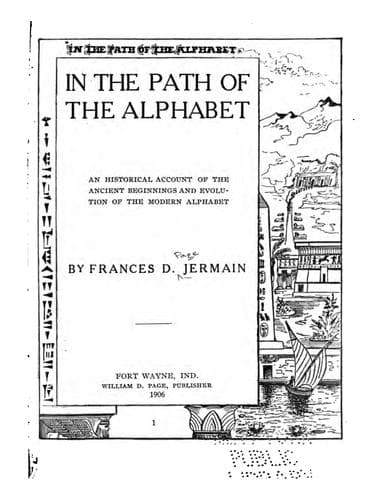
In the path of the alphabet: an historical account of the ancient beginnings and evolution of the modern alphabetJermain, Frances Delavan Page
History
In the path of the alphabet: an historical account of the ancient beginnings and evolution of the modern alphabet
Jermain, Frances Delavan Page
Alphabet
They had also priestly colleges, schools for scribes, and libraries as
at Erech, which was known as the “City of Books.”
These small states with their cities, were in the earliest times each
governed by “patesi,” priest-kings, corresponding to the “pastor
princes” of ancient China, or the Horsheshu, of ancient Egypt. Later on
as certain of these priest kings became more powerful, the neighboring
states and cities came under their domination, until finally we find all
southern Mesopotamia ruled by kings of Sumir, and northern Mesopotamia
by kings of Accad.
Of the explorations which have been undertaken of these older cities of
Chaldea, the most extensive are those which have occurred on the sites
of the ancient Nippur and at Tel-Loh, the ancient Shirpulla.
The former excavations, which have been conducted under the auspices of
the University of Pennsylvania, since the year 1888 to the present date,
have recovered the most ancient remains as yet discovered of these older
civilizations, dating, as estimated by Prof. Hilfrecht, from a period
about 7000 B. C.
This includes the enormous structure dedicated to the older Bel, which
had been rebuilt by successive monarchs, its later ruins rising to a
height of over one hundred feet above the plain, while its lower
foundations reach as great a depth below.
From this and other great buildings in the vicinity were obtained
sacrificial vessels, marble and silver vases, objects in gold and
bronze, stone door sockets and over thirty thousand clay tablets.
These include remains from the earliest periods of civilization to the
latest Babylonian history, from the earliest primitive Sumerian rulers
to the latest Semitic kings.
They give records of powerful kings as rulers of Accad during the two
milleniums preceding the reigns of the great Sargon and his son,
Naram-Sin.
Of these two monarchs a great number of inscribed objects have been
obtained, some of the most important relics as yet discovered verifying
inscriptions found elsewhere of the extent of their power. Remains were
also found here of later kings of Ur and other cities of this region,
whose names elsewhere appear as great builders or restorers of ancient
temples.
Of this earlier period, that of the “patesi,” or priest kings, some very
wonderful records have been discovered by M. de Sarzec at Tel-Loh. The
group of mounds of which Tel-Loh is the chief, is the site of a very
ancient city in southern Mesopotamia, the ancient Zirgul, or Sirgulla.
It is situated between the Tigris and Euphrates, near the junction of
the former river with the Shat-el-Hic, a small river which flows
southwesterly to the Euphrates, connecting the waters of these two great
rivers.
The mound of Tel-Loh, “The Mound of the Idol,” formed part of the royal
quarter of the ancient city, rising at this point forty feet above the
plain.
Public-domain text, read in full here on John Shaqi.
Reviews
Reviews
No reviews yet
Be the first to share your thoughts on this work.
Join the Discussion
Join the discussion
Sign in to leave a comment or review.
Sign InorCreate an account