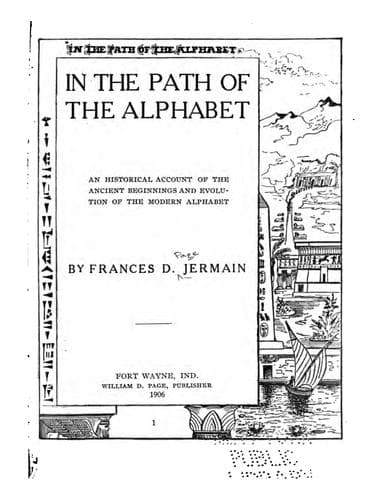
In the path of the alphabet: an historical account of the ancient beginnings and evolution of the modern alphabet — John Shaqi
In the path of the alphabet: an historical account of the ancient beginnings and evolution of the modern alphabetJermain, Frances Delavan Page
History
In the path of the alphabet: an historical account of the ancient beginnings and evolution of the modern alphabet
Jermain, Frances Delavan Page
Alphabet
It was in this locality that, in 1880-1881, M. de Sarzec, French consul
at Bagdad, who was carrying on excavations in this region under the
direction of the French government, came upon ten statues in the ruins
of a very ancient structure.
This proved to be the royal residence of an ancient king of Zirgul, the
patesi, or priest-king Gudea, whose date is fixed by various authorities
at about 4800 B. C.
The statues were nearly life size, and all were headless. Two heads soon
after were found in the ruins, one of them turbaned and the other
uncovered and shaved, supposed to represent the king as priest.
The type of feature reproduced in these finely sculptured heads is
unmistakably Turanian, of the Tartar branch of this great family, while
the turban, another characteristic indication in costume, might serve
for a copy in sculpture of the head dress worn by some living
representative of this race in central Asia at the present day.
All these statues were inscribed; nine of them with memorials of Gudea,
and the tenth of Urbahu, an earlier king who ruled in Zirgul before
Gudea.
The ruins of his palace were found by M. de Sarzec below the palace of
Gudea, and also the foundations of an ancient pyramid temple first
erected by Urbahu and rebuilt by Gudea.
The inscriptions were in very archaic cuneiform and were incised upon
the robes of the figures. Upon the principal statue of Gudea were
inscribed three hundred and thirty-six lines of writing, divided into
nine columns. About one hundred and thirty characters are used, and
these texts represent the longest of the ancient cuneiform writings
found.
The material of the statues is a peculiar variety of granite, a dark
green diorite, one of the hardest of stones. This was nowhere to be
found in Mesopotamia. So far as known, it only appears in the peninsula
of Sinai.
Again, the facility and skill in the manipulation of the material has
indicated that the tools used for the work must have been of the hardest
metals. They are supposed to have been of the hardest bronze. But this
presupposes an amazing antiquity for the practice of metallurgy.
The replies to the question, from whence the bronze? are now abundant,
and come from a variety of sources, but the testimony from the
inscriptions of the statues is the most direct and ample, opening before
us a commercial intercourse between nations and people of these regions
scarcely suspected of such very remote dates.
There are indications that even in these early days tin from Cornwall
was exported to these far off regions.
The inscriptions relate chiefly to the building of a pyramid temple by
Urbahu, and on the Gudea statues to the rebuilding of the temple by this
later prince.
Referring constantly to himself as patesi, or priest-king, he says that
for this purpose his God, Nin-Girsu, has opened the way for him “from
the sea of the highlands,”—the Persian Gulf—“to the upper sea,” the
Mediterranean.
Public-domain text, read in full here on John Shaqi.
Reviews
Reviews
No reviews yet
Be the first to share your thoughts on this work.
Join the Discussion
Join the discussion
Sign in to leave a comment or review.
Sign InorCreate an account