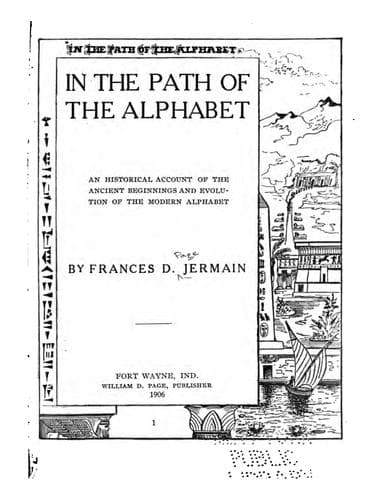
In the path of the alphabet: an historical account of the ancient beginnings and evolution of the modern alphabet — John Shaqi
In the path of the alphabet: an historical account of the ancient beginnings and evolution of the modern alphabetJermain, Frances Delavan Page
History
In the path of the alphabet: an historical account of the ancient beginnings and evolution of the modern alphabet
Jermain, Frances Delavan Page
Alphabet
VII. MESOPOTAMIAN INFLUENCE, 85
VIII. BABYLONIAN CONTRIBUTIONS, 99
IX. THE TEL-EL-AMARNA LETTERS, 113
X. PROTO-MEDIC ALPHABET, 134
XI. ZOROASTER AND MAHOMET, 147
------------------------------------------------------------------------
ILLUSTRATIONS.
MRS. FRANCES D. JERMAIN, Frontispiece
The Rosetta Stone, Opp. Page 9
Hieratic and Hieroglyphic Writings, “ 20
Cuneiform Vowels and Consonants, “ 26
Form of Rebus Script, “ 34
Hieroglyphic and Hieratic Figures, “ 40
Hieroglyphic Translation, “ 54
Hieroglyphic Hymn of Praise, “ 66
Hieroglyphic Signs and Equivalents, “ 98
Hieroglyphs and Translation, “ 112
------------------------------------------------------------------------
[Illustration: THE ROSETTA STONE.]
------------------------------------------------------------------------
CHAPTER I.
OF all the splendid achievements of archæological research during the
present century, there are none of more universal interest and
importance than those which are revealing the origin and history of
letters; this, not alone for the historic values of these discoveries,
for their illumination of a past of which hitherto there was but a faint
conception; but also for what letters have to tell us in explanation or
confirmation of Biblical narrative, of their bearing upon our most
sacred beliefs.
At the beginning of the present century the great mass of testimony now
laid open before us was an apparently impenetrable mystery. Egyptian
hieroglyphics and cuneiform inscriptions yet remained, for the most
part, but confusion of ornament and meaningless signs. Some little
advance, it is true, had been reached during the latter part of the
eighteenth century, as to the signification of certain hieroglyphic
characters, but these were as yet but conjecture; a groping in the dark,
with no means to verify, uncertain, unassured.
With the opening of the present century two events occurred which were
to place in the hands of scholars the keys to these mysteries. The first
in date of these discoveries, though not in results, was the finding of
the Rosetta Stone in 1799.
Public-domain text, read in full here on John Shaqi.
Reviews
Reviews
No reviews yet
Be the first to share your thoughts on this work.
Join the Discussion
Join the discussion
Sign in to leave a comment or review.
Sign InorCreate an account