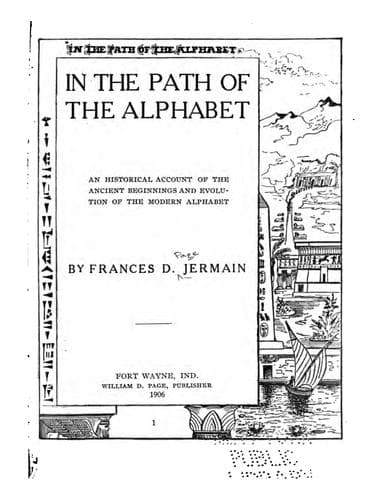
In the path of the alphabet: an historical account of the ancient beginnings and evolution of the modern alphabetJermain, Frances Delavan Page
History
In the path of the alphabet: an historical account of the ancient beginnings and evolution of the modern alphabet
Jermain, Frances Delavan Page
Alphabet
Here, long ages before the time of Hiram, king of Tyre, the friend of
David and Solomon; long ages even before the days of Abraham, the ships
of Gudea were navigating the seas from the trading ports of Ur and
Eridu, then at the mouth of the Euphrates on the Persian Gulf; coasting
down the shores of the Arabian peninsula, which they circumnavigated,
into the waters of the Red Sea; sailing northward to Magan, “the
enclosed port,” on the peninsula of Sinai, where the diorite for the
statues was obtained, and perhaps copper also from the Wady Magarah,
“the land of bronze;” then to various trading ports of the Egyptian
coasts, for gold from Meroe, and for timber from Ethiopia, and then for
the return voyage.
Other confirmation of the trade communications of southern Mesopotamia
with the peninsula of Sinai appears in the beautiful statue of Kephren,
the builder of the second pyramid, now in the Boulak museum. This statue
was recently exhumed from the sands of the desert near the great Sphynx
in Egypt, and is of stone so similar to the diorite of the Tel-Loh
statues that it is evident they were both obtained from the same source.
We know in this connection, that Seneferu, a predecessor of Kephren, had
conquered and held in possession the Sinaitic peninsula with a strong
garrison of Egyptian troops, which were maintained here during his reign
and the reign of his immediate successors; that under this protection
the fine stone of this region was quarried, and that at Wady Margarah
the rich mines of copper, turquoise and other precious stones were
worked.
Another evidence of the contact of Gudea with Egypt is the fact that on
the lap of the principal statue of Gudea the plan of the city is carved,
and the scale of measurement used is the “pyramid inch,” instead of the
Babylonian or Chaldean.
Aside from this, the finish, detail and workmanship of the Tel-Loh
statues is so similar in style and character to the statue of Kephren
that they all suggest the same influence and the same school of
sculpture.
There are many evidences from other sources of the commercial
intercourse between the Babylonians and Egyptians at these early dates,
and it is probable that the cities of Eridu and Ur may have maintained
the same relations in the prehistoric commerce of the Persian Gulf which
obtained in later times with Tyre and Sidon on the Mediterranean. The
commercial horizon thus opening before us is a broad one but is
constantly extending.
The natural depressions of the Mesopotamian valley extend from the
Persian Gulf northerly and northwesterly, thence through the Orontes
valley to the Mediterranean. In prehistoric times and for long ages this
was “the highway of nations,” by the great rivers, the Tigris and
Euphrates, from sea to sea, the chief trade route between India and the
western coasts of Asia Minor.
Public-domain text, read in full here on John Shaqi.
Reviews
Reviews
No reviews yet
Be the first to share your thoughts on this work.
Join the Discussion
Join the discussion
Sign in to leave a comment or review.
Sign InorCreate an account