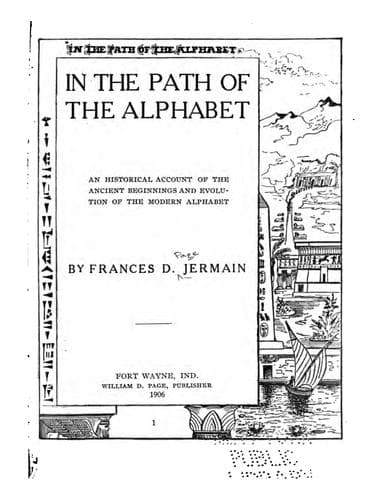
In the path of the alphabet: an historical account of the ancient beginnings and evolution of the modern alphabetJermain, Frances Delavan Page
History
In the path of the alphabet: an historical account of the ancient beginnings and evolution of the modern alphabet
Jermain, Frances Delavan Page
Alphabet
“I,” says Gudea, “made the lordly temple of the God who enlightens the
darkness; of costly woods I made it for him; with wood from Lebanon
(Amanus); wood of seventy and fifty cubits. I raised its roof
twenty-five cubits high.”
From the copper and silver mines of the Taurus, near “the great pass,”
“the gate of Syria,” copper was brought for the great pillars. Marble
also from the “Mountain of Canaan,” (Tidalum), in Phœnicia, for the
foundations. He sent ships to upper Egypt, where gold was obtained for
the porch of the temple. “To the country of Gubi and to the country of
Nituk which possesses every kind of tree, vessels to be laden with all
sorts of trees for Sippara I have sent.”
Sippara, “The City of the Bright Flame,” was another name by which
Zirgul was known. Reference to this comes in the inscriptions concerning
the “God who enlightens the darkness.”
Then of his statues he says: “Strong stone being brought from Magan
(Sinaitic peninsula) I made an image therewith that my name may be
remembered gloriously.”
Again of this statue he says: “Neither in silver, nor in copper, nor in
tin, nor in bronze let any one undertake the execution. An image
yielding none of these no man will demand as spoil; made of hard stone
may it remain in the place thereof, forever.”
These statues thus had a peculiar religious significance. Placed in the
sacred temple, always before the god to whose service they were
dedicated, they were supposed to represent the king constantly in life,
and like the “Ka” statues of the Egyptian kings, to be the residence of
the soul of the departed prince which was thus ever reverently before
his god. Thus we can understand the terrible curse pronounced by Gudea
upon whosoever should remove this statue from its place.
This and the companion statues from Tel-Loh, were nevertheless sent to
Paris and placed in the Louvre, where they will receive more distinction
than has been accorded them for ages. Perhaps this, and also the fact
that the inscriptions on them could not be read until they were placed
where competent Assyriologists could have access to them, may induce the
Ka of Gudea to revoke his maledictions should they threaten this later
disturber of his repose.
However this may be, the view thus given of this far off time, of which
we have no trace in history, is one of the most interesting
archæological discoveries of the century.
Public-domain text, read in full here on John Shaqi.
Reviews
Reviews
No reviews yet
Be the first to share your thoughts on this work.
Join the Discussion
Join the discussion
Sign in to leave a comment or review.
Sign InorCreate an account