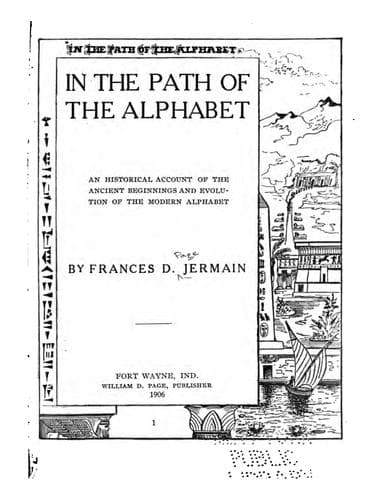
In the path of the alphabet: an historical account of the ancient beginnings and evolution of the modern alphabet — John Shaqi
In the path of the alphabet: an historical account of the ancient beginnings and evolution of the modern alphabetJermain, Frances Delavan Page
History
In the path of the alphabet: an historical account of the ancient beginnings and evolution of the modern alphabet
Jermain, Frances Delavan Page
Alphabet
The demotic text has never yet been fully translated. This writing is a
cursive script, developed from the hieratic to express the vulgar
dialect spoken by the people. As hieratic bears the same relation to
hieroglyphic that ordinary writing does to printing, so the demotic,
which is a further abridgment of the hieratic, is compared to the latter
as bearing the same relation which short-hand does to writing. Some of
these latent signs have been identified, but not all.
The first five lines of a Papyrus (containing 75 lines),
being the beginning of an ancient hymn addressed to the
Deity, are added in the original Hieratic, with the
transcription in Hieroglyphic characters. The Hieratic is
read from right to left, the Hieroglyphic from left to
right. The dots in the middle or end of the lines, written
in red ink in the original manuscript, indicate that this is
a poetic composition.
------------------------------------------------------------------------
[Illustration: HIERATIC AND HIEROGLYPHIC WRITINGS.]
------------------------------------------------------------------------
-----
Footnote 1:
Ancient Coptic Churches of Egypt. Vol. II. P. 47.
CHAPTER II.
THE other event referred to, which was to open to scholars another field
of research, in interest and importance equal to the Egyptian
discoveries, was the work of Grotefend, early in the century, in the
decipherment of cuneiform inscriptions.
In many parts of Persia, there are to be found engraved upon the native
rocks, or upon ruined temples, inscriptions in peculiar characters.
These characters are called cuneiform, because they are made up from
combinations of a single sign resembling the head of an arrow or a thin
wedge. This sign was formed in three ways, either horizontal, [—];
vertical, [|]; or angular, [<]. From these primary signs, a great
variety of combinations appear, either in groups or forming single
characters.
In the latter part of the eighteenth century, fragments of these
inscriptions, and copies of others, had found their way to Europe and
into the hands of scholars. Although some of the most powerful
intellects of Europe had attempted their interpretation, but little, if
any progress had been made until the beginning of the past century.
In the year 1802, Grotefend, then a young student in the University of
Bonn, announced to his colleagues his success in the decipherment of a
trilingual inscription copied by Niebuhr from the ruins of a royal
palace at Persepolis. It will be remembered that this young scholar had
no Rosetta Stone, with an inscription in a known language to indicate
either subject or language; simply the strange combinations of these
singular signs.
Public-domain text, read in full here on John Shaqi.
Reviews
Reviews
No reviews yet
Be the first to share your thoughts on this work.
Join the Discussion
Join the discussion
Sign in to leave a comment or review.
Sign InorCreate an account