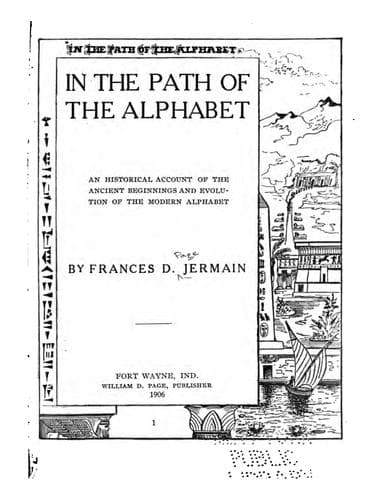
In the path of the alphabet: an historical account of the ancient beginnings and evolution of the modern alphabetJermain, Frances Delavan Page
History
In the path of the alphabet: an historical account of the ancient beginnings and evolution of the modern alphabet
Jermain, Frances Delavan Page
Alphabet
The extensive use of Phœnician and Greek alphabets in Egypt and
throughout the Orient, for some centuries before the Christian era, had
affected the Egyptian script as a social and commercial medium. The
hieroglyphics, however, held their own with the priesthood, for sacred
and secular uses, until the time of the Emperor Trajanus Decius,
249-252, A. D., which is the latest period in which we find them
employed for monumental purposes.
A little over a century later,—with the spread of Christianity, the
decline of paganism, the destruction of the Egyptian temples and the
dispersion of the priesthood under the Emperor Theodosius,—the
interpretation of the hieroglyphics was gradually lost, not again to be
read and understood until the discovery and interpretation of the
Rosetta Stone.
In 1822 Champollion announced the results of his studies to the “Academy
of Inscriptions” of Paris, and followed this by the publication of his
work on the “Hieroglyphic System of the Ancient Egyptians,” in which he
discussed the proofs that the phonetic alphabet was used in the royal
legends of all ages and is the key to the whole hieroglyphic system.
It will be remembered that those who before Champollion had undertaken
the decipherment of the Egyptian hieroglyphics, had based their efforts
on the theory that these signs were mainly ideographic. With this as a
working theory, all advance was impossible. Champollion, on the
contrary, finding the Egyptian system including a phonetic structure,
made this a basis for research, achieving a brilliant success. He never
fully recognized the composite character of these phonetic signs. From
these he constructed an alphabet of nearly two hundred signs, to which
his pupil, Salvolini, added one hundred more, thus producing an alphabet
of nearly three hundred characters. As Lepsius was to show a little
later, while these signs are all phonetic, only a small
number—thirty-four in all—are alphabetic, the remainder representing
syllables.
It is impossible, in this brief survey, to refer to the special
advancements made by other distinguished scholars in this field of
research. Since the death of Champollion the work of decipherment has
progressed steadily on until the life, the literature and the language
of the old Egyptians are open pages which all may read.
There are, however, many things not yet fully understood. Of the Rosetta
Stone, two of the texts may now be said to be fully translated; namely,
the Greek and the hieroglyphic. This has not been possible until
recently, in consequence of the mutilated condition of the tablet, a
considerable portion of the hieroglyphic text and part of the demotic,
being included in the fragment broken off and lost. Not long ago,
however, another stele was found at En Nobeira, near Dammamour,
containing a duplicate copy of the Rosetta texts in perfect condition.
This is now in the museum at Boulak.
Public-domain text, read in full here on John Shaqi.
Reviews
Reviews
No reviews yet
Be the first to share your thoughts on this work.
Join the Discussion
Join the discussion
Sign in to leave a comment or review.
Sign InorCreate an account