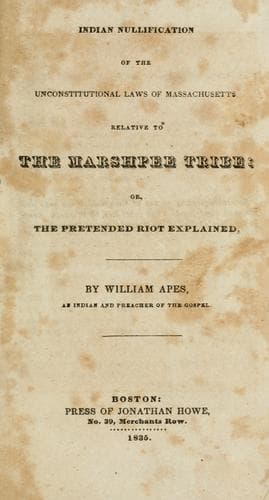
Indian Nullification of the Unconstitutional Laws of Massachusetts Relative to the Marshpee Tribe: Or, the Pretended Riot ExplainedApess, William
History
Indian Nullification of the Unconstitutional Laws of Massachusetts Relative to the Marshpee Tribe: Or, the Pretended Riot Explained
Apess, William
Indians of North America -- Legal status, laws, etc.; Mashpee Indians -- Land tenure; Mashpee Indians -- Legal status, laws, etc.
To this instrument there are about a hundred signatures, which were
affixed to the other papers above mentioned also. The resolutions
which were sent to the two bodies were these:
_Resolved_, That we, as a tribe, will rule ourselves, and have
the Constitutionso; for all men are born free and equal, says
the Constitutien of the country.
_Resolved_, That we will not permit any white man to come upon
our plantation, to cut or carry off wood or hay, or any other
article, without our permission, after the 1st of July next.
_Resolved_, That we will put said resolutions in force after
that date, (July next,) with the penalty of binding and
throwing them from the plantation, if they will not stay away
without.
These resolutions were adopted by the tribe, and put in force, as will
be seen hereafter. It was hoped that, though the whites had done all
they could to extinguish all sense of right among the Indians, they
would now see that they had feelings as well as other men.
The petition to the corporation of Harvard set forth the general
dissatisfaction of the tribe with the missionary sent them by that
honorable body, according to the intended application of the Williams
Fund. The money was no more intended for Mr. Fish than for any other
clergyman; neither had the Indians given him a call. They thought it
right to let his employers know that he had not done his duty, because
he not only received between five and six hundred dollars from the
college, but had possession of five or six hundred acres of the
tribe's best woodland, without their consent or approbation, and
converted them to his own exclusive use, pretending that his claim and
right to the same was better than that of the owners themselves. Not
liking this, the Indians solicited his discharge. The document runs
thus:
To our white brethren at Harvard College and trustees of the
Williams fund, that is under the care of that body, for the
important use of converting the poor heathen in New England,
and who, we understand, by means of that fund, have placed
among us the Rev. Phineas Fish.
We thought it very likely that you would like to know if we,
as a people, respected his person and labors, and whether the
money was benefiting the Indians or not. We think it our duty
to let you know all about it, and we do say, as the voice of
one, with but few exceptions, that we as a tribe, for a long
time, have had no desire to hear Mr. Fish preach, (which is
about ten years) and do say sincerely that we, as a body, wish
to have him discharged, not because we have anything against
his moral character, but we believe his labors would be more
useful somewhere else, and for these reasons,
Public-domain text, read in full here on John Shaqi.
Reviews
Reviews
No reviews yet
Be the first to share your thoughts on this work.
Join the Discussion
Join the discussion
Sign in to leave a comment or review.
Sign InorCreate an account