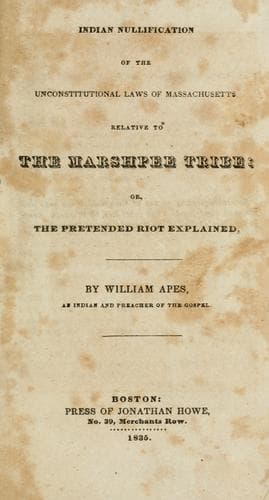
Indian Nullification of the Unconstitutional Laws of Massachusetts Relative to the Marshpee Tribe: Or, the Pretended Riot ExplainedApess, William
History
Indian Nullification of the Unconstitutional Laws of Massachusetts Relative to the Marshpee Tribe: Or, the Pretended Riot Explained
Apess, William
Indians of North America -- Legal status, laws, etc.; Mashpee Indians -- Land tenure; Mashpee Indians -- Legal status, laws, etc.
I now inquired what provision could be made for me, if I should
consent to their wishes. They answered that their means were small,
but that they would provide a house for me to live in, and do what
they could for my support. I said that, knowing their poverty, I did
not expect much, and gave them to understand that I could dig, and
fish, and chop wood, and was willing to do what I could for myself.
The subject of religious instruction was then discussed, and the
inquiry was made, what should be done with their poor, blind brother,
(who was then absent among another sect.) I answered that I was very
willing, to unite my labours with his, as there was plenty of work for
both of us; and that had I but half a loaf of bread, I would gladly
divide it with him. It was then agreed that we should unite, and
journey together on the road toward heaven.
The case Of Mr. Fish was next laid before the council, and Complaints
were made, that he had neglected his duty; that he did not appear to
care for the welfare of the tribe, temporal or spiritual; that he had
never visited some of the brethren at all, and others only once in
five or seven years; that but eight or ten attended his preaching;
that his congregation was composed of white people, to whom his visits
were mostly confined, and that it seemed that all he appeared to
care for was to get a living, and make as much as he could out of the
Indians, who could not see any reason to think him their friend.
It was, therefore, agreed to discharge him, and three papers were
draughted accordingly. One was a petition to the Governor and Council,
a second to the Corporation of Harvard College; the first complaining
against the Overseers, and the laws relating to the tribe; and the
second against the missionary set over them by Harvard College and the
Overseers. The third document was a statement of my adoption into the
tribe, and was signed by all present, and subsequently by others, who
were not present, but were equally desirious of securing their rights.
It was as follows,
_To all whom it may concern, from the beginning of the world
up to this time, and forever more_.
Be it known, that we, the Marshpees, now assembled in the
presence of God, do hereby agree to adopt the Rev. William
Apes, of the Pequod tribe, as one of ours. He, and his wife,
and his two children, and those of his descendants, forever,
are to be considered as belonging to the Marshpee tribe of
Indians. And we solemly avow this, in the presence of God, and
of one another, and do hereby attach our names to the same,
that he may take his seat with us and aid us in our affairs.
Done at the Council House in Marshpee, and by the authority of
the same, May 21st, 1833.
EBENEZER ATTAQUIN, _President_.
ISRAEL AMOS, _Secretary_.
Public-domain text, read in full here on John Shaqi.
Reviews
Reviews
No reviews yet
Be the first to share your thoughts on this work.
Join the Discussion
Join the discussion
Sign in to leave a comment or review.
Sign InorCreate an account