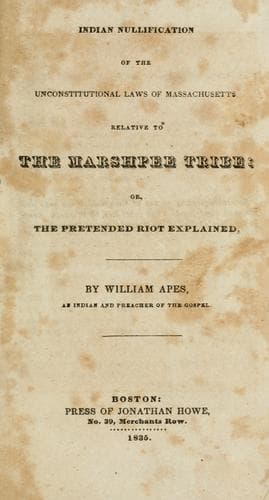
Indian Nullification of the Unconstitutional Laws of Massachusetts Relative to the Marshpee Tribe: Or, the Pretended Riot ExplainedApess, William
History
Indian Nullification of the Unconstitutional Laws of Massachusetts Relative to the Marshpee Tribe: Or, the Pretended Riot Explained
Apess, William
Indians of North America -- Legal status, laws, etc.; Mashpee Indians -- Land tenure; Mashpee Indians -- Legal status, laws, etc.
Soon after this, the Selectmen, one of whom was a member of my
church, applied to Mr. Fish respecting holding the Camp-meeting on the
parsonage. The place selected could not have disturbed Mr. Fish, any
more than people passing in carriages in the main road. We had no
Meeting-house, our School-houses would not hold the people, and we had
no other means but to erect our tents and worship God in the open air.
A pious family of whites from Nantucket, came on the ground, and began
erecting their tent. Mr. Fish came there in person and ordered them
off. The man told him that he had his family there, and had no other
shelter for the night but his tent, which he should not remove, but
would do so the next day, if he found that he was trespassing on
any man's rights. But he added, if Mr. Fish turned him off, he would
publish his conduct to the world. Mr. Fish's interference to break
up our religious meeting, created much talk, and finally he wrote the
following letter to the Selectmen; after which we went on and had our
meeting, in a quiet, orderly and peaceful manner, and we believe it
was a season of grace, in which the Lord blessed us.
_To the Selectmen of Marshpee_.
On mature thought, and in compliance with your particular
request, I consent to your holding the Camp-meeting, which
is this day commenced, on the spot near the river, where the
first tent was erected. I consent, (I say,) on the following
conditions, viz: That you undertake that no damage come upon
the parsonage property, either wood land, or Meeting-house;
that no attempt be made to occupy the Meeting-house; that
there be no attempt on the Sabbath, or any other day, to
interrupt the customary worship at the Meeting-house, and,
_that peace, order, and quietude_ be maintained during the
time of the Camp-meeting. It is also distinctly understood,
that this license is of _special favor_, and _not conceded as
your right_, and no way to be taken as a ground for similar
requests in future, or for encouraging any future acts of
annoyance, vexation, or infringement of the quiet possession
of the privileges, secured to me by the _Laws_. And that
should any damage be done in any way as aforesaid, you will
consider yourselves responsible to the proper authorities.
With my best wishes for your welfare, your friend,
PHINEAS FISH.
_Marshpee, July 30, 1834_.
The reader may now ask, how came Mr. Fish in possession of this
property, which he claims to hold by the Laws? I am at liberty to
publish here, the following views of the law and the facts in the
case, drawn up by legal counsel whom the Selectmen have consulted. And
here I take my leave.
OPINION AS TO THE TITLE REV. PHINEAS FISH HAS TO THE PARSONAGE, SO
CALLED, IN MARSHPEE.
Public-domain text, read in full here on John Shaqi.
Reviews
Reviews
No reviews yet
Be the first to share your thoughts on this work.
Elsewhere in the archive
Join the Discussion
Join the discussion
Sign in to leave a comment or review.
Sign InorCreate an account