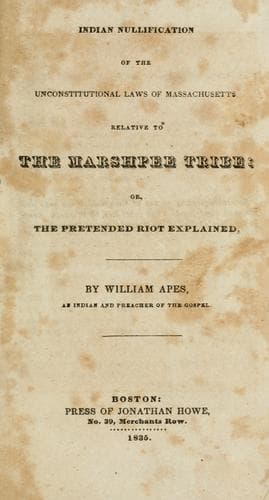
Indian Nullification of the Unconstitutional Laws of Massachusetts Relative to the Marshpee Tribe: Or, the Pretended Riot ExplainedApess, William
History
Indian Nullification of the Unconstitutional Laws of Massachusetts Relative to the Marshpee Tribe: Or, the Pretended Riot Explained
Apess, William
Indians of North America -- Legal status, laws, etc.; Mashpee Indians -- Land tenure; Mashpee Indians -- Legal status, laws, etc.
There is one other consideration that might legally deprive Mr.
Fish of his rights in the parsonage, even if he acquired any by the
transaction in 1811, which is denied. When he went to Marshpee, and
first preached there, he was of the Unitarian faith, and so continued
some time. Subsequently, (and most undoubtedly from high conscientious
motives,) he became Orthodox in his creed, and has remained so ever
since. [This fact has been named by the President of Harvard College,
as one reason why the Williams fund has continued to be diverted from
its proper use; the delicacy Harvard College felt at dismissing Mr.
Fish, lest it should be ascribed to persecution, for his change of
sentiments from Unitarian to Orthodox.]
But if Mr. Fish claims to hold the parsonage by the "_laws_," he must
be governed by the decision of the Court in the celebrated case
of Burr, vs. the first parish in Sandwich. Mr. Burr was settled an
Unitarian, and became Orthodox, and this the Supreme Court decided was
just cause for the parish to dismiss him. Chief Justice Parsons,
said in that case, that "according to the almost immemorial usage
of Congregational churches, before the parish settle a minister, he
preaches with them as a candidate for settlement, with the intent of
declaring his religious faith, and if he is afterwards settled, it is
understood that the greater part of the parish and church agree in his
religious sentiments and opinions. If afterwards the minister adopts
a new system of divinity, the parish retaining their former religious
belief, so that the minister would not have been settled on his
present system, in our opinion the parish have good cause to
complain." On this ground the Court decided that Mr. Burr had
forfeited his settlement.
The principle is the same applied to the relation Mr. Fish holds
to the Marshpee Indians. He was placed over them by others, and the
Indians are now compelled either to lose all the benefits of their own
parsonage, or to hear a man in whose doctrines they do not believe,
and whom they cannot consent to take as their spiritual teacher.
Upon a full investigation into this branch of the inquiry, there seems
to be no legal or equitable ground, on which Mr. Fish can claim to
hold the parsonage and Meeting-house against the Proprietors, and he
must therefore, be regarded as a trespasser, liable to be ejected,
and the men he employs to cut and cart wood from the plantation, are
liable to indictment under the new law of 1834.
Public-domain text, read in full here on John Shaqi.
Reviews
Reviews
No reviews yet
Be the first to share your thoughts on this work.
Elsewhere in the archive
Join the Discussion
Join the discussion
Sign in to leave a comment or review.
Sign InorCreate an account