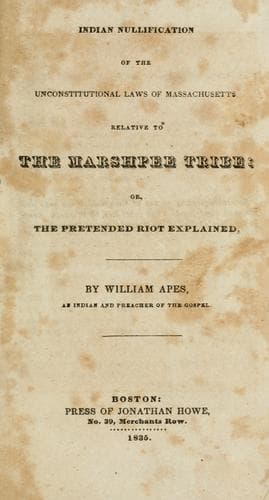
Indian Nullification of the Unconstitutional Laws of Massachusetts Relative to the Marshpee Tribe: Or, the Pretended Riot ExplainedApess, William
History
Indian Nullification of the Unconstitutional Laws of Massachusetts Relative to the Marshpee Tribe: Or, the Pretended Riot Explained
Apess, William
Indians of North America -- Legal status, laws, etc.; Mashpee Indians -- Land tenure; Mashpee Indians -- Legal status, laws, etc.
The invalidity of title, is however, a still stronger ground against
Mr. Fish's right of adverse occupancy, which he now holds, and a case
in principle precisely like this, has been decided by the Supreme
Court of Massachusetts. It occurred in 1798, before there was a
reporter of the Supreme Court. Hon John Davis, United States District
Judge, was counsel for the Indians, and Samuel Dexter, for the
defendant. It was tried on a demurrer, before the Supreme Court in
Barnstable, upon an action of ejectment, Proprietors of Marshpee, vs.
Ebenezer Crocker. Judge Paine delivered the opinion of the Court in
favor of the Indians. Judge Benjamin Whitman of Boston, was also, we
believe, concerned in the cause. The substance of the case, as stated
by Judge Davis and Judge Whitman, was thus:
Ebenezer Crocker of Cotuet, had furnished an Indian woman, (known
as the Indian Queen,) with supplies for many years. She occupied and
claimed in severalty as her own, a valuable tract of about 200 acres
of land on the Marshpee Plantation, called the neck, of which tract
she gave a deed in fee, some time before her death, to said Crocker,
in consideration of the support he had given her. The consideration
at that time, was not very greatly disproportioned to the value of
the land. After her death, she having left no heirs, the grantee,
Mr. Crocker, who was an influential member of the General Court,
petitioned that body and procured a full confirmation of the deed
to him, in the same manner the General Court in 1809, confirmed the
parsonage deed of 1783, except that there was not so long a time
intervening between Mr. Crocker's receiving the deed from the Indian
Queen in her life time, and its full confirmation by the General Court
after her death.
This took place previous to the law of 1788, putting the Indians under
guardianship, when either the law of 1693 or the charter of 1763, was
in force.[3] When the white Overseers came in, in 1798, they found
Crocker in possession of this land, under the above title, and they
employed Judge John Davis, as counsel, to vacate the deed and the
act of the General Court. Judge Davis brought an action of ejectment
against Crocker, (not in the name of the Overseers,) but in the name
of the Proprietors of Marshpee, whose property he claimed, was as
tenants in common, on the ground that the old Queen, though she
occupied it in severalty during her life, could not, as one tenant in
common, convey the interest of her co-tenants in common. It was tried
in the Supreme Court, and the deed was set aside, for insufficiency
of title. This insufficiency of title vitiated the conveyance on the
ground that the old Queen had no power to convey when she made the
deed, and that the General Court had no power to make good, by a
resolve, a title originally invalid.
Public-domain text, read in full here on John Shaqi.
Reviews
Reviews
No reviews yet
Be the first to share your thoughts on this work.
Elsewhere in the archive
Join the Discussion
Join the discussion
Sign in to leave a comment or review.
Sign InorCreate an account