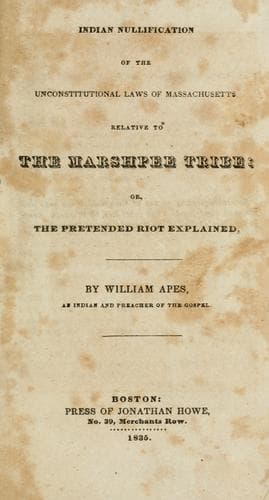
Indian Nullification of the Unconstitutional Laws of Massachusetts Relative to the Marshpee Tribe: Or, the Pretended Riot ExplainedApess, William
History
Indian Nullification of the Unconstitutional Laws of Massachusetts Relative to the Marshpee Tribe: Or, the Pretended Riot Explained
Apess, William
Indians of North America -- Legal status, laws, etc.; Mashpee Indians -- Land tenure; Mashpee Indians -- Legal status, laws, etc.
Crocker also set up the claim of quiet possession, for thirty years,
which it was supposed would secure the title; but the Court decided
that this gave no title, and the land was restored to the Indians, and
now forms a portion of their common land. Mr. Crocker of course, lost
all he had furnished to the old Queen, and in this respect, his
case was harder than it would be, were Mr. Fish dispossessed of the
parsonage, after enjoying it for twenty-four years, without any title
thereto. It would he difficult for any lawyer to show why Crocker's
deed confirmed by the General Court, should have been set aside in
1798, and Lot Nye's deed, of the parsonage, be held valid in 1834.
On referring to my minutes of the trial of the petition of the
Indians, for their liberty, in 1834, before a Committee of the
Legislature, I find the following facts stated by Rev. Phineas Fish,
who was a witness before that Committee. They will throw some light on
the subject of inquiry.
_Rev. Phineas Fish_, sworn. Testifies that he was ordained
at Marshpee in 1811. Was invited there by the Overseers of
Marshpee. There were five persons of color belonging to the
church, and sixteen whites. At the ordination, a white
man rose up and protested against it. He said all were not
satisfied. It was not a vote of the Indians by which he was
settled, and no vote of the church was taken. Five Indians had
expressed a wish that he would remain. He received two-thirds
of the Williams fund, from Harvard College. It had varied from
390 to 433 dollars. Received about 150 dollars per year from
the wood-land of the parsonage. Has built a dwelling house,
and made improvements on an acre and a half of land of the
plantation, of which he holds a deed from the Overseers,
confirmed by a resolve of the General Court.
_Mr. Gideon Hawley_ testified that the Meeting-house was
built by the funds of the English Society for propagating the
gospel, before 1757, when his father was sent as a missionary
to the Indians, by the London Missionary Society. In 1817,
five hundred dollars were granted on petition of the Indians,
as a donation by the Legislature, to repair the church for the
Marshpee Indians. After Mr. Fish had preached in Marshpee, 5
Indians came to Mr. Hawley and expressed a wish he would stay
with them. There was no vote and no record. Before his father
came to Marshpee, in 1757, Bryant, an Indian preacher, used to
preach to the Indians, in the Meeting-house. The missionary,
(Mr. Hawley,) received one hundred dollars annually, from
Harvard College, of the Williams fund. In 1778, the Indians
gave the missionary, Mr. Hawley, two hundred acres of land,
which witness inherits. [The validity of this title is not
disputed.]
Public-domain text, read in full here on John Shaqi.
Reviews
Reviews
No reviews yet
Be the first to share your thoughts on this work.
Elsewhere in the archive
Join the Discussion
Join the discussion
Sign in to leave a comment or review.
Sign InorCreate an account