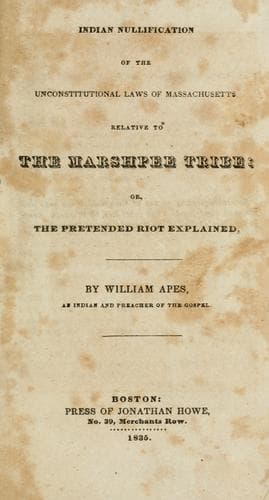
Indian Nullification of the Unconstitutional Laws of Massachusetts Relative to the Marshpee Tribe: Or, the Pretended Riot Explained — John Shaqi
Indian Nullification of the Unconstitutional Laws of Massachusetts Relative to the Marshpee Tribe: Or, the Pretended Riot ExplainedApess, William
History
Indian Nullification of the Unconstitutional Laws of Massachusetts Relative to the Marshpee Tribe: Or, the Pretended Riot Explained
Apess, William
Indians of North America -- Legal status, laws, etc.; Mashpee Indians -- Land tenure; Mashpee Indians -- Legal status, laws, etc.
Some feared that an insurrection might break out among the colored
people, in which blood might be shed. Some called me an imposter, and
others approved of my proceedings, especially the Quakers, whom I ever
found benevolent and ready to help us. Their generous good will toward
colored people of all races is well known. I feel bound to say, too,
that there were others of the highest respectability in those parts
who were anxious that their red brethren should obtain their rights
and redress of their grievances.
When the time I had fixed for my return to my friends at Marshpee
arrived, I turned thitherward, and reached the place on the sixth of
June. Here I met the blind preacher, whom I had never before seen. He
bade me welcome, and cordially agreed to join me in my labors, saying
that God had listened to his prayers. He had for several years prayed
for an assistant, and now consented to labor in conjunction with me
for the spiritual and temporal advantage of our brethren. We went
through the plantation together. On the Sabbath there was a large
meeting, and the assistance of God enabled me to preach to them, after
which we set forth, as a delegation to the Governor and Council in
Boston. We stopped at several towns by the way, to discharge our
duties, as Christian ministers, and were kindly and hospitably
received by the teachers.
When we arrived in Boston, we communicated our business to a certain
doctor, who lived in Roxbury. He did not think so favorably of it as
we had expected; but, nevertheless, agreed to lay it before the board
of trustees, which we presume he did, as he is a man of truth. We told
him that we asked for justice, not money, and said that we wished the
Marshpee Indians to avoid the meeting-house, if it did not belong to
them. With this we left him, and have never heard from him from that
day to this. He is gone where his deeds done in the flesh will receive
their just reward; which I hope is a crown of blessedness and glory.
We did not find the Governor in Boston; but were advised to wait on
Mr. Armstrong, the Lieut. Governor. We showed him our petition and
resolutions, which he said, would avail us nothing, unless enforced.
We answered that they would be enforced, at the appointed time. He
then suggested that we might have been instigated to the measures
in question by some of our enemies; probably meaning some of our
unprincipled white neighbors. We replied that ill usage had been our
only instigation, and that no one had interfered in the matter. He
advised us to deliver our petition to the Secretary of State, to be
submitted to the Council at their next session; which we did.
Public-domain text, read in full here on John Shaqi.
Reviews
Reviews
No reviews yet
Be the first to share your thoughts on this work.
Join the Discussion
Join the discussion
Sign in to leave a comment or review.
Sign InorCreate an account