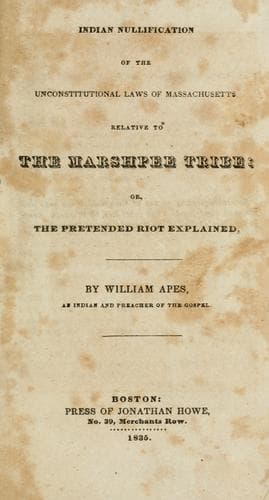
Indian Nullification of the Unconstitutional Laws of Massachusetts Relative to the Marshpee Tribe: Or, the Pretended Riot ExplainedApess, William
History
Indian Nullification of the Unconstitutional Laws of Massachusetts Relative to the Marshpee Tribe: Or, the Pretended Riot Explained
Apess, William
Indians of North America -- Legal status, laws, etc.; Mashpee Indians -- Land tenure; Mashpee Indians -- Legal status, laws, etc.
This done, we called on one of the tribe who was engaged in the
coasting business, and had done much to teach the Indians, and to
bring them to a right knowledge of their degraded condition. He said
that he would willingly relinquish his business, and join in the
efforts of his brethren to shake off the yoke which galled them; and
thereupon it was resolved to hold a convention on the twenty-fifth of
June, for the purpose of organizing a new government. He desired to be
there, and his name is Daniel Amos.
I now set out for Essex, where my family was living, accompanied by
the blind preacher. I put my wife and little ones on board a small
vessel, bound for Boston, while I and my blind brother returned
thither by land. We all arrived safely, and soon after embarked for
Barnstable, where we arrived on the eighteenth of June, and landed at
a spot about twelve miles distant from the hospitable Indians. Here
we found ourselves breathing a new atmosphere. The people were very
little prepossessed in our favor, and we certainly owe them small
thanks on the score of hospitality. We succeeded in obtaining the
shelter of an old stable for two nights, by paying two dollars. We
applied to one individual for accommodations during that time, for one
of our party who was sick, but were refused. He said he had no room.
If any white man should come to Marshpee and ask hospitality for a
night or two, I do not believe that one of the whole tribe would turn
him from his door, savages though they be. Does not he better deserve
the name who took from us two dollars for sleeping in his stable? This
usage made me think that in this part of New England prejudice was
strong against the poor children of the woods, and that any aid we
might receive must come from the more hospitable Indians, among whom
we arrived on the twenty-first, and rested till the twenty-fifth. We
regarded ourselves, in some sort, as a tribe of Israelites suffering
under the rod of despotic Pharaohs; for thus far, our cries and
remonstrances had been of no avail. We were compelled to make our
bricks without straw.
We now, in our synagogue, for the first time, concerted the form of a
government, suited to the spirit and capacity of free born sons of the
forest; after the pattern set us by our white brethren. There was but
one exception, viz. that _all_ who dwelt in our precincts were to
be held free and equal, _in truth_, as well as in letter. Several
officers, twelve in all, were elected to give effect to this novelty
of a government; the chief of whom were Daniel Amos, President, and
Israel Amos, Secretary. Having thus organized ourselves, we gave
notice to the former board of overseers, and the public at large, of
our intentions. This was the form of our proclamation:
NOTICE.
_Marshpee Plantation, June 25th, 1833_.
Public-domain text, read in full here on John Shaqi.
Reviews
Reviews
No reviews yet
Be the first to share your thoughts on this work.
Join the Discussion
Join the discussion
Sign in to leave a comment or review.
Sign InorCreate an account