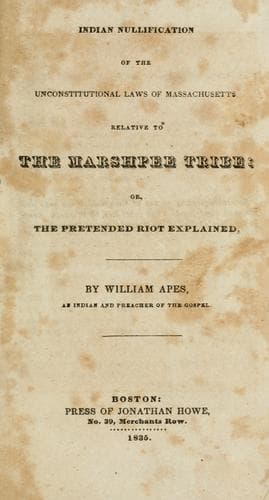
Indian Nullification of the Unconstitutional Laws of Massachusetts Relative to the Marshpee Tribe: Or, the Pretended Riot ExplainedApess, William
History
Indian Nullification of the Unconstitutional Laws of Massachusetts Relative to the Marshpee Tribe: Or, the Pretended Riot Explained
Apess, William
Indians of North America -- Legal status, laws, etc.; Mashpee Indians -- Land tenure; Mashpee Indians -- Legal status, laws, etc.
At the time appointed, we met the Counsellor, and he appeared to enjoy
himself very well among us. When the meeting had been called to
order, it was observed that the Overseers were not present, and it was
proposed to send for them, that they might have fair play and hear
of what faults they were accused. They came, accompanied by the
High Sheriff of Barnstable County, the Hon. J. Reed of Yarmouth, and
several other whites, who were invited to take seats among us. The
excitement which pervaded Cape Cod had brought these people to our
council, and they now heard such preaching in our meeting-house as
they had never heard there before; the bitter complainings of the
Indians of the wrongs they had suffered. Every charge was separately
investigated by our people, who gave the entire day to the work. The
white persons present seemed very uneasy; often getting up, going out
and returning, as if apprehensive of some danger. The ground work of
their fears, if they had any, was this: Three of our people, who had
been out in the morning, hunting deer, had brought their guns into the
meeting house, and this circumstance was thought, or pretended to be
thought by a few of our neighbors to portend violence and murder. Also
the Counsellor had brought a letter from the Governor, indicating that
he had been led, by wrong reports, to believe that something of the
kind was likely to take place.[2]
This letter was read to the people, and was to them as a provocation
and a stimulus. They thought it grievous that the Governor should
think they had put him in mind of his oath of office, to secure the
Commonwealth from danger, and given him cause to call out perhaps
fifty or sixty thousand militia; especially when the great strength
and power of the Marshpee tribe was considered. To this supposed great
demonstration of military power they might, possibly, have opposed
a hundred fighting men and fifteen or twenty rusty guns. But it is
written, "One shall chase a thousand, and two shall put ten thousand
to flight;" so there might have been some reason for persons who
believe the Bible to fear us. Who can say that little Marshpee might
not have discomfitted great Massachusetts. Nevertheless, the birth
place of American freedom was spared so great a disgrace; for the
governor, very wisely, remained at home.
Toward the close of the day Mr. Fiske desired the Hon. Mr. Reed
to explain to the Indians the laws, as they then stood, and the
consequences of violating them. He told us that merely declaring a law
to be oppressive could not abrogate it; and that it would become us,
as good citizens whom the government was disposed to treat well, to
wait for the session of the Legislature, and then apply for relief.[3]
"He went fully," says one reporter, whose name it may be well to
omit, "into the situation of the tribe, in a very forcible and feeling
manner, warning them against the rash measures they had already taken
or adopted."
Public-domain text, read in full here on John Shaqi.
Reviews
Reviews
No reviews yet
Be the first to share your thoughts on this work.
Join the Discussion
Join the discussion
Sign in to leave a comment or review.
Sign InorCreate an account