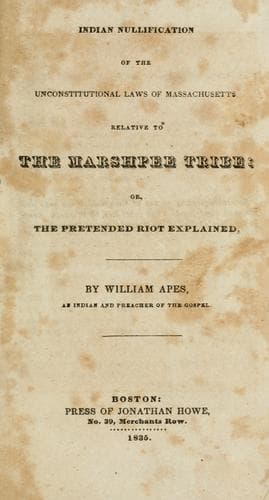
Indian Nullification of the Unconstitutional Laws of Massachusetts Relative to the Marshpee Tribe: Or, the Pretended Riot ExplainedApess, William
History
Indian Nullification of the Unconstitutional Laws of Massachusetts Relative to the Marshpee Tribe: Or, the Pretended Riot Explained
Apess, William
Indians of North America -- Legal status, laws, etc.; Mashpee Indians -- Land tenure; Mashpee Indians -- Legal status, laws, etc.
Mr. Fiske then pathetically stated his opinions concerning the awful
consequences which would result from a violation of the laws, and
spoke much at large of the parental feeling of government for the
remnant of a once mighty and distinguished race. Wm. Apes replied
that the laws ought to be altered without delay; that it was perfectly
manifest that they were unconstitutional, and that, even if they were
not so, there was nothing in them to authorize the white inhabitants
to act as they had done. Being very anxious to learn what amount of
good his brethren might expect, he spoke with an energy that alarmed
some of the whites present considerably. The Hon. Mr. Reed questioned
him as to his right to interfere. He replied that he had obtained it
by the adoption of the tribe.
Mr. Reed, if I correctly understood him, answered that the Indians
had no right to do such an act; no power to confer such a privilege. I
replied, that if the plantation belonged to them, they undoubtedly had
a right to give me leave to dwell upon it. Many other things he
said of which I could not see the reasonableness and propriety, and
therefore we could not come to an agreement.
While these things were being done and said, as I have reason to
believe, a warrant for my apprehension was put into the hands of the
High Sheriff, who, it appeared to me, was not very desirous to execute
it. He approached me, and with some agitation, told me I must go with
him to Catuiot; and added, that if I did not accompany him peaceably,
he would have out the whole county of Barnstable. I was not conscious
of giving any cause for this perturbation of mind, but I suppose
others saw my conduct in a different light. It is admitted by all that
nothing was done contrary to good order, though I admit, that if I had
refused to obey the warrant, the Sheriff would not have been able to
enforce it. The fact is I was in no wise unwilling to go with him, or
to have my conduct brought to the test of investigation, or to give
all the satisfaction that might be required, had it appeared that I
had done wrong. I was also very desirous to have the truth appear,
viz. that it was not the intention or wish of the Marshpees to do
violence or shed blood.
The Sheriff told me that I should not suffer any injury or injustice,
and that I should have a hearing in the presence of my friend, Mr.
Fiske. I went with him very quietly. The excitement ran very high, and
almost all Cotuet was present at my examination. If wishes could have
availed, I doubt not that I should have been ruined forever. I was
arraigned on three charges: for riot, assault, and trespass; and
pleaded NOT GUILTY.
Public-domain text, read in full here on John Shaqi.
Reviews
Reviews
No reviews yet
Be the first to share your thoughts on this work.
Join the Discussion
Join the discussion
Sign in to leave a comment or review.
Sign InorCreate an account