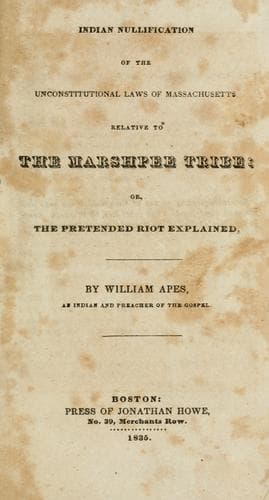
Indian Nullification of the Unconstitutional Laws of Massachusetts Relative to the Marshpee Tribe: Or, the Pretended Riot ExplainedApess, William
History
Indian Nullification of the Unconstitutional Laws of Massachusetts Relative to the Marshpee Tribe: Or, the Pretended Riot Explained
Apess, William
Indians of North America -- Legal status, laws, etc.; Mashpee Indians -- Land tenure; Mashpee Indians -- Legal status, laws, etc.
While I was waiting for Mr. Ewer, to bail me, I had some conversation
with the Hon. J.J. Fiske, who expressed himself concerned about the
Indians, and thought that something ought to be done. I said to him
that my object was to get them righted, and allowed that I might
possibly have gone too fast and far. In this I am now satisfied that
I was mistaken. I believe that neither I nor any of my brethren went
fast enough. I think there is no white man, Christian or Infidel,
who would have shown half so much forbearance as we did in the like
circumstances. Mr. Fiske said he would do all he could for me, and I
have no doubt that he did so. It was very proper in him to endeavor
to quiet the whites. The Indians were already quiet, and had no
disposition to be otherwise.
Nevertheless, it seemed to be the common opinion that the imprisonment
of Apes would frighten the rest of the tribe, and cause them to forego
their efforts to recover their rights. Had this been the case, they
might have carted a few more good suppers and dinners out of our
woods, and have eaten them on their town meeting days, for two or
three days together, twice in the year, and have thrown the bones and
crusts to the poor, old and ignorant, among the natives, as they had
done, year after year. The missionary, as usual, might have helped
them to devour the spoil, and have seen his flock degraded and abused,
before his eyes. Much was also said about the pains that had been
taken to educate the Marshpees, and it was averred, that, instead of
going to the schools opened for them, they preferred going about the
country picking berries, and basket making. Mr. Crocker said he had
been at great pains to induce the Indians to go to school. Let him who
has been prejudiced against the Marshpees, by such argument, look
at the legislative act of 1789, section 5, for the regulation of the
plantation, prohibiting the instruction of the Marshpees, in reading
and writing, under pain of death. Who, then, dared to teach them?
Public-domain text, read in full here on John Shaqi.
Reviews
Reviews
No reviews yet
Be the first to share your thoughts on this work.
Join the Discussion
Join the discussion
Sign in to leave a comment or review.
Sign InorCreate an account