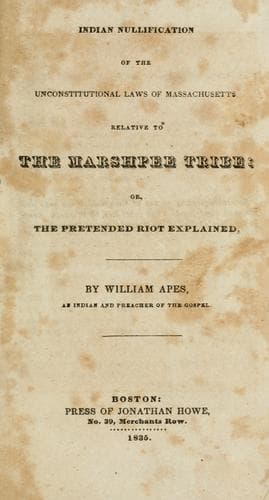
Indian Nullification of the Unconstitutional Laws of Massachusetts Relative to the Marshpee Tribe: Or, the Pretended Riot ExplainedApess, William
History
Indian Nullification of the Unconstitutional Laws of Massachusetts Relative to the Marshpee Tribe: Or, the Pretended Riot Explained
Apess, William
Indians of North America -- Legal status, laws, etc.; Mashpee Indians -- Land tenure; Mashpee Indians -- Legal status, laws, etc.
Mr. Hawley, the former missionary, spent fifty or sixty years in
Marshpee. He is mentioned in the history of Berkshire County, as a
schoolmaster, for the Mohawks, Onedias and Tuscaroras, in 1748, and
nothing more is known of him, up to his arrival in Marshpee. Thither
he came to teach, in A.D. 1757, and there he staid till his death.
What his care to educate the tribe was, may be judged from the facts
that he _did not teach one_ Indian to read during his residence among
them, as I am informed by those who knew him. He had probably imbibed
the opinion that the natives were incapable of being taught, and
therefore spared himself trouble that he thought would be of no use.
Nevertheless, he was willing to preach to them, and had a good portion
of their land set off for his support. Truth obliges me to say that
not one Indian was converted during the fifty years of his ministry.
The neighbouring whites were the sole recipients of the good resulting
from his labors, if there was any. Speaking on this subject, the Rev.
Cotton Mather Smith says that the arrangements for managing Indian
schools were never thoroughly made; admirable as was the general plan,
and much as it promised. I think I may safely vouch for the truth and
honesty of the reverend gentleman's admission.
Mr. Fish succeeded Mr. Hawley, in 1809, and was confirmed in his
office by the authorities at Harvard, and the white overseers at
Marshpee. The arrangement was sanctioned by the General Court, in
1811; contrary to law, as we think. Surely it takes two sides to make
a bargain, and the consent of the Indians was never asked or obtained.
Both of the divines mentioned above were willing to have the use of
the property of the Marshpees; I fear, under a mere pretext of doing
them good; and, therefore, that they and the overseers might have a
support from the plantation, the owners were constantly proclaimed
to be savages. I wonder what the whites would say, should the Indians
take possession of any part of their property. Many and many a red man
has been butchered for a less wrong than the Marshpees complain of.
Public-domain text, read in full here on John Shaqi.
Reviews
Reviews
No reviews yet
Be the first to share your thoughts on this work.
Join the Discussion
Join the discussion
Sign in to leave a comment or review.
Sign InorCreate an account